Sunday, April 15, 2012

African Liberation Day


"Today we are one.  If in the past the Sahara divided us, now it unites us..." 
 Osageyfo Kwame Nkrumah
Conference of Independent African States, April 15, 1968

Ghana achieved independence from Britain on March 6, 1957 but Prime Minister (later President) Osagefyo Dr Kwame Nkrumah believed that; "Ghana's freedom would be meaningless if it was not linked with the total liberation of the entire continent of Africa," or as Sekou Toure later put it "the liberty of Africa is indivisible."  For Nkrumah,

Africa was not, "and can never be an extension of Europe."  

"Africa must unite," Nkrumah concluded and, therefore, within a year of his country's Independence, proceeded to organize a meeting of African independent states to consider African liberation.  The states included Egypt which attained independence in 1922, Ethiopia (date unknown), Liberia (1847), Libya (1951), Morocco (1956), Sudan (1956), Tunisia (1956), Ghana (1957), which Nkrumah referred to as the "only eight independent truly African states.
On April 15, 1958, in the city of Accra, Ghana, African leaders and political activists gathered at the first Conference of Independent African States. It was attended by representatives of the governments of Egypt (which attended as part of the United Arab Republic), Ethiopia, Ghana, Liberia, Libya, Morocco, Sudan, Tunisia, and representatives of the National Liberation Front of Algeria, and the Union of the Peoples of Cameroon. The conference was significant in that it represented the first pan-African Conference held on African soil.
"After 500 years of the most brutal suffering known to humanity, the rape of Africa and the subsequent slave trade, which cost Africa in excess of 100,000,000 of her children, the masses of African People singularly, separately, individually, in small disconnected groupings for centuries had said, “enough”! But in 1958, at the Accra Conference, it was being said in ways that emphasized joint, coordinated and unified action. "   http://www.thetalkingdrum.com/ald.html


 The Conference called for the founding of African Freedom Day, a day to “mark each year the onward progress of the liberation movement, and to symbolize the determination of the People of Africa to free themselves from foreign domination and exploitation.”

"African Liberation Day for us is only an instrument to help organize our people..." 
Kwame Ture

Five years later, after the First Conference of Independent African States in the Ethiopian capital Addis Ababa, another historic meeting occurred. On May 25, 1963, leaders of thirty-two independent African States met to form the Organization of African Unity (OAU). By then more than two thirds of the continent had achieved independence, mostly from imperial European states. At this meeting, the date of Africa Freedom Day was changed from April 15 to May 25, and Africa Freedom Day was declared African Liberation Day (ALD). 

About Nkrumah 
The Rt. Hon. Dr. Kwame Nkrumah was the leader of Ghana and its predecessor state, the Gold Coast, from 1952 to 1966. Overseeing the nation's independence from British colonial rule in 1957, Nkrumah was the first President of Ghana and the first Prime Minister of Ghana. An influential 20th-century advocate of Pan-Africanism, he was a founding member of the Organization of African Unity and was the winner of the Lenin Peace Prize in 1963.


About Ghana
The word Ghana means Warrior King and was the title accorded to the kings of the medieval West African Ghana Empire.   There is archaeological evidence showing that humans have lived in present-day Ghana since the Bronze Age.   By the early 11th century, the Akan were firmly established in a state called Bonoman. From the 13th century, numerous groups emerged from what is believed to have been the Bonoman area, to create several Akan States, mainly based on gold trading. These states included Denkyira, Akwamu, and Akyem. The Ga and Dagomba states were established by the 16th century.  By the 19th century, most of modern Ghanaian territory was included in the Empire of Ashanti, one of the most influential states in sub-Saharan Africa prior to colonial rule. The Ashanti government operated first as a loose network, and eventually as a centralized kingdom with an advanced, highly specialized bureaucracy centered in Kumasi.
Flag of Ghana

Trade with European states began after contact with the Portuguese in the 15th century, and the British established the Gold Coast Crown colony in 1874 over parts but not all of the country.     The Gold Coast achieved independence from the United Kingdom in 1957, becoming the first sub-Saharan African nation to do so from European Colonialism. The name Ghana was chosen for the new nation to reflect the ancient Empire of Ghana, which once extended throughout much of west Africa.  The Flag of Ghana, became the new flag in 1957. Designed by, Theodosia Salome Okoh, the red represents the blood that was shed towards independence, the gold represents the mineral wealth of Ghana, the green symbolizes the rich agriculture, and the black star is the symbol of African emancipation.


Read more here:  http://www.aaprp-intl.org/index.html
http://africanliberationday.net/
http://allafrica.com/stories/201005240652.html
http://www.thetalkingdrum.com/ald.html
http://en.wikipedia.org/wiki/African_Liberation_Day
http://en.wikipedia.org/wiki/Kwame_Nkrumah

Saturday, April 7, 2012

Malawi's First Female President


Joyce Banda, President of Malawi

I was at church for an Easter play today and one of the ladies that was volunteering with me was just beside herself.  She told me she was so excited because her country, Malawi just got their first female president.  Joyce Banda, vice president, was sworn in as the new president of Malawi today in a ceremony today in the capital, Lilongwe. 

A winner of national and international awards for her work as a supporter of women's rights, Banda was last year named by Forbes Magazine as Africa's third most powerful female politician after Liberian President Ellen Johnson Sirleaf and Nigerian Minister of Finance Ngozi Okonjo-Iweala.


http://en.wikipedia.org/wiki/Malawi
http://www.msnbc.msn.com/id/46984487/ns/world_news-africa/
http://abcnews.go.com/blogs/headlines/2012/04/new-president-malawi-second-woman-head-of-state-africa/

Wednesday, April 4, 2012

The Negro Speaks of Rivers

In honor of National Poetry Month... Langston Hughes poetry:

The Negro Speaks of Rivers 

I've known rivers: 
I've known rivers ancient as the world and 
older than the flow of human blood in human veins. 
 My soul has grown deep like the rivers. 
 I bathed in the Euphrates when dawns were young. 
I built my hut near the Congo and it lulled me to sleep. 
I looked upon the Nile and raised the pyramids above it. 
I heard the singing of the Mississippi when Abe Lincoln
 went down to New Orleans, and I've seen its muddy 
 bosom turn all golden in the sunset. 
I've known rivers: 
Ancient, dusky rivers. 
 My soul has grown deep like the rivers.

Listen to Langston read it himself here:  http://www.poets.org/viewmedia.php/prmMID/15722

The Poetry and Leadership of Langston Hughes:
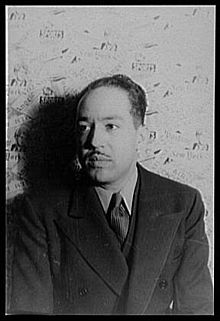
Langston Hughes
1902 - 1967
First published in The Crisis in 1921, "The Negro Speaks of Rivers", which became Hughes's signature poem, was collected in his first book of poetry The Weary Blues (1926). Hughes's life and work were enormously influential during the Harlem Renaissance of the 1920s, alongside those of his contemporaries, Zora Neale Hurston, Wallace Thurman, Claude McKay, Countee Cullen, Richard Bruce Nugent, and Aaron Douglas. Except for McKay, they worked together also to create the short-lived magazine Fire!! Devoted to Younger Negro Artists. Hughes, who claimed Paul Lawrence Dunbar, Carl Sandburg, and Walt Whitman as his primary influences, is particularly known for his insightful, colorful portrayals of black life in America from the twenties through the sixties.   As one of the founders of the Harlem Renaissance, which he practically defined in his essay, "The Negro Artist and the Racial Mountain" (1926).

Langston was more than a poet, he was an activist as well. Hughes was unashamedly black at a time when blackness was démodé. He stressed the theme of "black is beautiful" as he explored the black human condition in a variety of depths. His main concern was the uplift of his people, whose strengths, resiliency, courage, and humor he wanted to record as part of the general American experience. His poetry and fiction portrayed the lives of the working class blacks in America, lives he portrayed as full of struggle, joy, laughter, and music. Permeating his work is pride in the African-American identity and its diverse culture. "My seeking has been to explain and illuminate the Negro condition in America and obliquely that of all human kind," Hughes is quoted as saying. He confronted racial stereotypes, protested social conditions, and expanded African America’s image of itself; a “people’s poet” who sought to reeducate both audience and artist by lifting the theory of the black aesthetic into reality. An expression of this is this poem:

"My People" picture book by Charles R. Smith

"My People"
by Langston Hughes

The night is beautiful,
So the faces of my people.

The stars are beautiful,
So the eyes of my people

Beautiful, also, is the sun.
Beautiful, also, are the souls of my people.


In 1932, Hughes became part of a group of black people who went to the Soviet Union to make a film depicting the plight of African Americans in the United States. The film was never made, but Hughes was given the opportunity to travel extensively through the Soviet Union and to the Soviet-controlled regions in Central Asia, the latter parts usually closed to Westerners. While there, he met African-American Robert Robinson, living in Moscow and unable to leave. In Turkmenistan, Hughes met and befriended the Hungarian polymath Arthur Koestler. Hughes also managed to travel to China and Japan before returning to the States.

Partly as a show of support for the Republican faction during the Spanish Civil War, in 1937 Hughes traveled to Spain as a correspondent for the Baltimore Afro-American and other various African-American newspapers. Hughes initially did not favor black American involvement in the war because of the persistence of discriminatory U.S. Jim Crow laws existing while blacks were encouraged to fight against Fascism and the Axis powers. He came to support the war effort and black American involvement in it after deciding that blacks would also be contributing to their struggle for civil rights at home. When asked why he never joined the Communist Party, he wrote "it was based on strict discipline and the acceptance of directives that I, as a writer, did not wish to accept." In 1953, he was called before the Senate Permanent Subcommittee on Investigations led by Senator Joseph McCarthy.

In addition to leaving us a large body of poetic work, Hughes wrote eleven plays and countless works of prose, including the well-known “Simple” books: Simple Speaks His Mind, Simple Stakes a Claim,Simple Takes a Wife, and Simple's Uncle Sam. He edited the anthologies The Poetry of the Negro and The Book of Negro Folklore, wrote an acclaimed autobiography (The Big Sea) and co-wrote the play Mule Bone with Zora Neale Hurston.

In his memory, his residence at 20 East 127th Street in Harlem, New York City, has been given landmark status by the New York City Preservation Commission, and East 127th Street has been renamed "Langston Hughes Place."

You may also enjoy...

Related Posts Plugin for WordPress, Blogger...

EH Canvas Spotlight - Flow by Monica Stewart

EH Canvas Spotlight - Flow by Monica Stewart
Flow by Monica Stewart