Showing posts with label racial identity. Show all posts

Saturday, January 11, 2014

Harry Belafonte in Speech Honoring Steve McQueen

"Throughout the rest of my life ... on my birth certificate, it said "colored." Not long after that, I became "Negro." Not too long after that, I became "Black." Most recently, I am now "African-American." I spent the better part of almost a century just in search of, seeking, "Who am I? "
Harry Belafonte, in speech honoring Steve McQueen


Listen To Harry Belafonte’s New York Film Critics Circle Awards Speech On Race & Cinema | Shadow and Act
/

The power of cinema is an uncontainable thing and it's truly remarkable, in its capacity for emotional evolution. When I was first watching the world of cinema, there was a film that stunned the world, with all its aspects and art form. They did a lot, at that time. The film was done by D.W. Griffith, and it was called The Birth of a Nation, and it talked about America's story, its identity, and its place in the universe of nations. And that film depicted the struggles of this country with passion and power and great human abuse. Its depiction of Black people was carried with great cruelty. And the power of cinema styled this nation, after the release of the film, to riot and to pillage and to burn and to murder Black citizens. The power of film.
At the age of five, in 1932, I had the great thrill of going to the cinema. It was a great relief for those of us who were born into poverty, a way we tried to get away from the misery. One of the films they made for us, the first film I saw, was Tarzan of the Apes. [Ed note: The movie is called Tarzan the Ape Man.] In that film, [we] looked to see the human beauty of Johnny Weissmuller swinging through the trees, jump off, and there spring to life, while the rest were depicted as grossly subhuman, who were ignorant, who did not know their way around the elements, living in forests with wild animals. Not until Johnny Weissmuller stepped into a scene did we know who we were, according to cinema.
Throughout the rest of my life ... on my birth certificate, it said "colored." Not long after that, I became "Negro." Not too long after that, I became "Black." Most recently, I am now "African-American." I spent the better part of almost a century just in search of, seeking, "Who am I? What am I? What am I to be called? What do I say? Who do I appeal to? Who should I be cautious of?" In this life, when we walk into the world of cinema, we use the instrument that is our ability to try to give another impression of who and what we were as a people, and what we meant to this great nation called America. I'm glad that Sidney Poitier should step into this space right after the Second World War, and new images of what we are as people, certainly as men.
A lot's gone on with Hollywood. A lot could be said about it. But at this moment, I think what is redeeming, what is transformative, is the fact that a genius, an artist, is of African descent, although he's not from America, he is of America, and he is of that America which is part of his own heritage; [he] made a film called 12 Years a Slave, which is stunning in the most emperial way. So it's a stage that enters a charge made by The Birth of a Nation, that we were not a people, we were evil, rapists, abusers, absent of intelligence, absent of soul, heart, inside. In this film, 12 Years a Slave, Steve steps in and shows us, in an overt way, that the depth and power of cinema is there for now the world to see us in another way. I was five when I saw Tarzan of the Apes, and the one thing I never wanted to be, after seeing that film, was an African. I didn't want to be associated with anybody that could have been depicted as so useless and meaningless. And yet, life in New York led me to other horizons, other experiences. And now I can say, in my 87th year of life, that I am joyed, I am overjoyed, that I should have lived long enough to see Steve McQueen step into this space and for the first time in the history of cinema, give us a work, a film, that touches the depths of who we are as a people, touches the depths of what America is as a country, and gives us a sense of understanding more deeply what our past has been, how glorious our future will be, and could be.


Read more at EBONY http://www.ebony.com/black-listed/entertainment-culture/harry-belafonte-honors-steve-mcqueen-at-new-york-film-critics-circle-awards-981#ixzz2q4COV1P0 
Follow us: @EbonyMag on Twitter | EbonyMag on Facebook

Monday, September 2, 2013

Racial Identity Development Across the Diaspora

We have often explored issues of Black racial identity of African-Americans.  Today I ran across a blog post that made me consider racial identity across the African Diaspora.

Quite simply put, identity is a person's comprehension of themselves as a discrete, separate entity.  Racial identity development as often discussed in America is actually not based on ethnicity alone, but on culture as well.  Since history has produced varied experiences across the African diaspora, we recognize that racial identity development varies as well.  But people of African descent experience it differently in other countries.

"in the US, “one drop” of “black blood”, or African ancestry, made one black regardless of their physical appearance, many believe that, in Brazil, one drop of “white blood”, or European ancestry, could make one non-black or in some cases, white."

Read one man's experience of racial identity development in Brazil on the Black Women in Brazil blog on these two blogs here:


These are both great blogs and provide perspectives that are often not considered in America.

What do you learn about your own racial identity when considering how it differs in other countries?

Tuesday, April 30, 2013

Have you had "the talk" with your Black son?

Some people like to believe we live in a post race society and that racism is dead; unfortunately, racism is not dead.  I do not advocate overreacting or scaring our kids or making them overly sensitive or teaching them that our entire identity is based on victimization...we have to tell them the truth.

In an article I ran across today, the author shared 5 of the rules he received when he got "the talk" from his parents:
  1. Never Leave A Store Without A Shopping Bag
  2. Never Loiter Outside, Anywhere
  3. Never Go Anywhere Alone
  4. Never Talk Back To Police ... And Never, Ever Reach Into Your Pocket
  5. Never Doubt Trouble May Strike Anytime, Anywhere

"One of the things that black parents have done, and rather successfully...is on the one hand talk about a sense of being aware — being cautious — while also avoiding what we call destructive paranoia." 
William Cross, Jr., Author of Shades of Black

What do you think???  Is this really a big deal???  Some people may say this is overkill, but the fact remains that there are still some people in the world, in this country, that will see your son and only see what they perceive to be their stereotyped black kid.  It is sad, but it is true.  But why should this STILL be an issue? I mean, we are living in 2013 and there is no need for civil rights for African-Americans anymore, right???  Well, as Harry Belafonte said in an interview on Monday:


"in the 50's.. everything was quite visible, now all this is underground, you go through so much fighting these 'ghosts'"

Harry Belafonte

Check out the full interview on another blog here:

Sunday, April 21, 2013

Girl Like Me

So what does this mean?  70 years later and we still have an identity problem?

In 1939, Dr. Kenneth Clark and his wife Mamie conducted the Clark Doll Experiment where they asked black children to choose between a black doll and a white doll. The dolls were the same except for their skin color but most thought the white doll was nicer.

In 2005, Kiri Davis did the same experiment and came out with similar results:


Sunday, April 14, 2013

Black Gold


We are kicking off our racial identity development series here at Experiencing History, with Esperanza Spalding's song, "Black Gold."


Black Gold
by 
Esperanza Spalding

Hold your head as high as you can
High enough to see who you are, little man
Life sometimes is cold and cruel
Baby no one else will tell you so remember that 

You are Black Gold, Black Gold
You are Black Gold

Now maybe no one else has told you so
But you're golden, baby
Black Gold with a diamond soul
Think of all the strength you have in you 
From the blood you carry within you
Ancient men, powerful men
Built us a civilization

They'll be folks hell-bent on putting you down
Don't get burned
Not necessarily everyone will know your worth
Think of all the strength you have in you 
From the blood you carry within you
Ancient men, powerful men
Built us a civilization

Think of all the strength you have in you
Powerful, powerful men
Built us a civilization


Hold your head as high as you can
High enough to see who you are, little man
Life sometimes is cold and cruel
Baby no one else will tell you so remember that 

You are Black Gold, Black Gold
You are Black Gold

There'll be folks hell-bent on putting you down
Don't get burned
Not necessarily everyone will know your worth
Think of all the strength you have in you 
From the blood you carry within you
Ancient men, powerful men
Built us a civilization

Think of all the strength you have in you
Powerful, powerful men
Built us a civilization

Hold your head as high as you can
High enough to see who you are, little man
Life sometimes is cold and cruel
Baby no one else will tell you so remember that 

You are Black Gold, Black Gold
You are Black Gold

Think of all the strength you have in you 
From the blood you carry within you
Ancient men, powerful men
Built us a civilization

All the strength
All the blood
That you carry
Ancient men 
Powerful men
In you
Built us a civilization

Hold your head as high as you can
High enough to see who you are, little man
Life sometimes is cold and cruel
Baby no one else will tell you so remember that 

You are Black Gold, Black Gold
You are Black Gold

You are Black Gold, Black Gold
You are Black Gold

You are Black Gold, Black Gold
You are Black Gold

You are Black Gold, Black Gold
You are Black Gold

Hold your head as high as you can
High enough to see who you are, little man
Life sometimes is cold and cruel
Baby no one else will tell you so remember that 

You are Black Gold
You are Black Gold
You are
You are
You are
Hold your head up
Don't give up 
You are Black Gold 
You are 
You are
Black Gold
Black Gold, Black Gold, Black Gold

Monday, December 17, 2012

I'm Black and I'm Proud...Racial Pride in the African-American Community

"Our study provides empirical evidence that the longstanding practice in the African American community of cultivating racial pride and preparing children to face racial bias in society should be considered among appropriate and beneficial practices in parenting Black children"  
Ming-Te Wang

I've been working on leadership development curriculum that includes identity development, specifically racial identity development in youth. As a precursor to this, I plan to launch a racial identity series here on this blog in the spring.

Interesting enough, I ran across an article today online published on medicalxpress.com, "Can instilling racial pride in black teens lead to better educational outcomes?" The article talks about a University of Pittsburgh study published this fall in the journal Child Development. Titled "Parental Racial Socialization as a Moderator of the Effects of Racial Discrimination on Educational Success Among African American Adolescents," the research article shows that when African American parents use racial socialization—talking to their children or engaging in activities that promote feelings of racial knowledge, pride, and connection—it offsets racial discrimination's potentially negative impact on students' academic development. They plan to carry out the same study among Latino and Asian communities as well. Read the entire article here: http://medicalxpress.com/news/2012-12-instilling-racial-pride-black-teens.html

Wednesday, April 4, 2012

The Negro Speaks of Rivers

In honor of National Poetry Month... Langston Hughes poetry:

The Negro Speaks of Rivers 

I've known rivers: 
I've known rivers ancient as the world and 
older than the flow of human blood in human veins. 
 My soul has grown deep like the rivers. 
 I bathed in the Euphrates when dawns were young. 
I built my hut near the Congo and it lulled me to sleep. 
I looked upon the Nile and raised the pyramids above it. 
I heard the singing of the Mississippi when Abe Lincoln
 went down to New Orleans, and I've seen its muddy 
 bosom turn all golden in the sunset. 
I've known rivers: 
Ancient, dusky rivers. 
 My soul has grown deep like the rivers.

Listen to Langston read it himself here:  http://www.poets.org/viewmedia.php/prmMID/15722

The Poetry and Leadership of Langston Hughes:
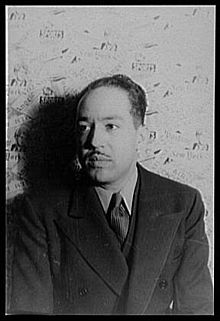
Langston Hughes
1902 - 1967
First published in The Crisis in 1921, "The Negro Speaks of Rivers", which became Hughes's signature poem, was collected in his first book of poetry The Weary Blues (1926). Hughes's life and work were enormously influential during the Harlem Renaissance of the 1920s, alongside those of his contemporaries, Zora Neale Hurston, Wallace Thurman, Claude McKay, Countee Cullen, Richard Bruce Nugent, and Aaron Douglas. Except for McKay, they worked together also to create the short-lived magazine Fire!! Devoted to Younger Negro Artists. Hughes, who claimed Paul Lawrence Dunbar, Carl Sandburg, and Walt Whitman as his primary influences, is particularly known for his insightful, colorful portrayals of black life in America from the twenties through the sixties.   As one of the founders of the Harlem Renaissance, which he practically defined in his essay, "The Negro Artist and the Racial Mountain" (1926).

Langston was more than a poet, he was an activist as well. Hughes was unashamedly black at a time when blackness was démodé. He stressed the theme of "black is beautiful" as he explored the black human condition in a variety of depths. His main concern was the uplift of his people, whose strengths, resiliency, courage, and humor he wanted to record as part of the general American experience. His poetry and fiction portrayed the lives of the working class blacks in America, lives he portrayed as full of struggle, joy, laughter, and music. Permeating his work is pride in the African-American identity and its diverse culture. "My seeking has been to explain and illuminate the Negro condition in America and obliquely that of all human kind," Hughes is quoted as saying. He confronted racial stereotypes, protested social conditions, and expanded African America’s image of itself; a “people’s poet” who sought to reeducate both audience and artist by lifting the theory of the black aesthetic into reality. An expression of this is this poem:

"My People" picture book by Charles R. Smith

"My People"
by Langston Hughes

The night is beautiful,
So the faces of my people.

The stars are beautiful,
So the eyes of my people

Beautiful, also, is the sun.
Beautiful, also, are the souls of my people.


In 1932, Hughes became part of a group of black people who went to the Soviet Union to make a film depicting the plight of African Americans in the United States. The film was never made, but Hughes was given the opportunity to travel extensively through the Soviet Union and to the Soviet-controlled regions in Central Asia, the latter parts usually closed to Westerners. While there, he met African-American Robert Robinson, living in Moscow and unable to leave. In Turkmenistan, Hughes met and befriended the Hungarian polymath Arthur Koestler. Hughes also managed to travel to China and Japan before returning to the States.

Partly as a show of support for the Republican faction during the Spanish Civil War, in 1937 Hughes traveled to Spain as a correspondent for the Baltimore Afro-American and other various African-American newspapers. Hughes initially did not favor black American involvement in the war because of the persistence of discriminatory U.S. Jim Crow laws existing while blacks were encouraged to fight against Fascism and the Axis powers. He came to support the war effort and black American involvement in it after deciding that blacks would also be contributing to their struggle for civil rights at home. When asked why he never joined the Communist Party, he wrote "it was based on strict discipline and the acceptance of directives that I, as a writer, did not wish to accept." In 1953, he was called before the Senate Permanent Subcommittee on Investigations led by Senator Joseph McCarthy.

In addition to leaving us a large body of poetic work, Hughes wrote eleven plays and countless works of prose, including the well-known “Simple” books: Simple Speaks His Mind, Simple Stakes a Claim,Simple Takes a Wife, and Simple's Uncle Sam. He edited the anthologies The Poetry of the Negro and The Book of Negro Folklore, wrote an acclaimed autobiography (The Big Sea) and co-wrote the play Mule Bone with Zora Neale Hurston.

In his memory, his residence at 20 East 127th Street in Harlem, New York City, has been given landmark status by the New York City Preservation Commission, and East 127th Street has been renamed "Langston Hughes Place."

Wednesday, February 1, 2012

Black Women in American Culture and History

When Carter G. Woodson established Negro History week in 1926, he realized the importance of providing a theme to focus the attention of the public.  The intention has never been to dictate or limit the exploration of the Black experience, but to bring to the public's attention important developments that merit emphasis. 

For those interested in the study of identity and ideology, an exploration of ASALH's Black History themes is itself instructive.  Over the years, the themes reflect changes in how people of African
descent in the United States have viewed themselves, the influence of social movements on racial ideologies, and the aspirations of the black community.

This year's theme "Black Women in American Culture and History" honors African American women and the myriad of roles they played in the shaping of our nation. The theme, chosen by the Association for the Study of African American Life and History urges all Americans to study and reflect on the value of their contribution to the nation.

History of Black History Month


Carter G. Woodson 
As a Harvard-trained historian, Carter G. Woodson, like W. E. B. Du Bois before him, believed that truth could not be denied and that reason would prevail over prejudice. His hopes to raise awareness of African American's contributions to civilization was realized when he and the organization he founded, the Association for the Study of Negro Life and History (ASNLH), conceived and announced Negro History Week in 1925. The event was first celebrated during a week in February 1926 that encompassed the birthdays of both Abraham Lincoln and Frederick Douglass. The response was overwhelming: Black history clubs sprang up; teachers demanded materials to instruct their pupils; and progressive whites, not simply white scholars and philanthropists, stepped forward to endorse the effort.

By the time of Woodson's death in 1950, Negro History Week had become a central part of African American life and substantial progress had been made in bringing more Americans to appreciate the celebration. At mid–century, mayors of cities nationwide issued proclamations noting Negro History Week. The Black Awakening of the 1960s dramatically expanded the consciousness of African Americans about the importance of black history, and the Civil Rights movement focused Americans of all color on the subject of the contributions of African Americans to our history and culture.

The celebration was expanded to a month in 1976, the nation's bicentennial. President Gerald R. Ford urged Americans to “seize the opportunity to honor the too-often neglected accomplishments of black Americans in every area of endeavor throughout our history.” That year, fifty years after the first celebration, the association held the first African American History Month. By this time, the entire nation had come to recognize the importance of Black history in the drama of the American story. Since then each American president has issued African American History Month proclamations. President Obama issued the 2012 annual proclamation just yesterday...http://www.whitehouse.gov/the-press-office/2012/01/31/presidential-proclamation-national-african-american-history-month-2012

And the association—now the Association for the Study of African American Life and History (ASALH)—continues to promote the study of Black history all year.


Wednesday, July 20, 2011

"Black Power"

On July 20 in Black History...

In 1967, The First Black Power Conference Was Held In Newark, New Jersey. In the tradition of the antebellum African American convention movement and the early Pan-African congresses, the National Conference on Black Power was a gathering of more than 1,000 delegates representing 286 organizations and institutions from 126 cities in 26 states, Bermuda, and Nigeria.Nathan Wright, Jr., was the conference chairman, and workshop coordinators included Ossie Davis, James Farmer, Hoyt Fuller, Nathan Hare, Maulana Ron Karenga, Cleveland Sellers, and Chuck Stone.

They met in Newark, NJ., from July 20 to July 23, 1967, to discuss the most pressing African American issues of the day. The conference held workshops, presented papers for specific programs, and developed more than 80 resolutions calling for emphasis of Black power in political, economic, and cultural affairs. Only one resolution, a Black Power Manifesto, won official approval, but others were adopted in “in spirit.” The Manifesto condemned “neo-colonialist control” of Black populations worldwide and called for the circulation of a “philosophy of Blackness” that would unite and direct the oppressed in common cause.
http://www.aaregistry.org/historic_events/view/black-power-conference-newark-held

http://sites.bergen.org/ourstory/Resources/civil_rights/newsclips2/67julyBlackpower.pdf


BLACK POWER
The Black Power movement grew out of the CIVIL RIGHTS MOVEMENT that had steadily gained momentum through the 1950s and 1960s. Although not a formal movement, the Black Power movement marked a turning point in black-white relations in the United States and also in how blacks saw themselves. The movement was hailed by some as a positive and proactive force aimed at helping blacks achieve full equality with whites, but it was reviled by others as a militant, sometimes violent faction whose primary goal was to drive a wedge between whites and blacks. In truth, the Black Power movement was a complex event that took place at a time when society and culture was being transformed throughout the United States, and its legacy reflects that complexity.

Not all blacks had been equally impressed with the civil rights movement. MALCOLM X and the NATION OF ISLAM, for example, felt that racial self-determination was a critical and neglected element of true equality. By the mid-1960s, dissatisfaction with the pace of change was growing among blacks. The term "black power" had been around since the 1950s, but it was STOKELY CARMICHAEL, head of the STUDENT NONVIOLENT COORDINATING COMMITTEE (SNCC), who popularized the term in 1966.

Carmichael led a push to transform SNCC from a multiracial community activist organization into an all-black social change organization. Late in 1966, two young men, HUEY NEWTON and BOBBY SEALE, formed the BLACK PANTHER PARTY FOR SELF-DEFENSE (BPP), initially as a group to track incidents of police violence. Within a short time groups such as SNCC and BPP gained momentum, and by the late 1960s the Black Power movement had made a definite mark on American culture and society.
Also, because the Black Power movement was never a formally organized movement, it had no central leadership, which meant that different organizations with divergent agendas often could not agree on the best course of action. The more radical groups accused the more mainstream groups of capitulating to whites, and the more mainstream accused the more radical of becoming too ready to use violence. By the 1970s, most of the formal organizations that had come into prominence with the Black Power movement, such as the SNCC and the Black Panthers, had all but disappeared.

The Black Power movement did not succeed in getting blacks to break away from white society and create a separate society. Nor did it help end discrimination or racism. It did, however, help provide some of the elements that were ultimately necessary for blacks and whites to gain a fuller understanding of each other.

Read more: Black Power Movement - Blacks, Rights, Whites, Civil, White, and Racial http://law.jrank.org/pages/4776/Black-Power-Movement.html#ixzz1Uw4lhf3b

Tuesday, February 15, 2011

Maya Angelou, John Lewis and Bill Russell Receive the Presidential Medal of Freedom

"the best of who we are and who we aspire to be" 
President Barack Obama

Today, President Obama honored fifteen recipients of the Presidential Medal of Freedom at a ceremony at the White House. As the President said, “These outstanding honorees come from a broad range of backgrounds and they’ve excelled in a broad range of fields, but all of them have lived extraordinary lives that have inspired us, enriched our culture, and made our country and our world a better place. I look forward to awarding them this honor.”The Nation’s highest civilian honor, the 2010 Medal of Freedom is presented to individuals who have made especially meritorious contributions to the security or national interests of the United States, to world peace, or to cultural or other significant public or private endeavors.  The following individuals received the Presidential Medal of Honor Today:

•President George H. W. Bush - George Herbert Walker Bush was the 41st President of the United States.
•Chancellor Angela Merkel - Angela Merkel is the Chancellor of the Federal Republic of Germany.
•Congressman John Lewis - John Lewis is an American hero and a giant of the Civil Rights Movement.
•John H. Adams - John H. Adams co-founded the Natural Resources Defense Council in 1970.
•Maya Angelou - Dr. Maya Angelou is a prominent and celebrated author, poet, educator, producer, actress, filmmaker, and civil rights activist, who is currently the Reynolds Professor of American Studies at Wake Forest University.
•Warren Buffett - Warren Buffett is an American investor, industrialist, and philanthropist. He is one of the most successful investors in the world.
•Jasper Johns - American artist Jasper Johns has produced a distinguished body of work dealing with themes of perception and identity since the mid-1950s.
•Gerda Weissmann Klein - Gerda Weissmann Klein is a Jewish Holocaust survivor who has written several books about her experiences.
•Dr. Tom Little (Posthumous) - Dr. Tom Little was an optometrist who was brutally murdered on August 6, 2010, by the Taliban in the Kuran Wa Munjan district of Badakhshan, Afghanistan, along with nine other members of a team returning from a humanitarian mission to provide vision care in the remote Parun valley of Nuristan.
•Yo-Yo Ma - Yo-Yo Ma is considered the world’s greatest living cellist, recognized as a prodigy since the age of five whose celebrity transcends the world of classical music.
•Sylvia Mendez - Sylvia Mendez is a civil rights activist of Mexican and Puerto Rican descent.
•Stan Musial - Stan “The Man” Musial is a baseball legend and Hall of Fame first baseman for the St. Louis Cardinals. Musial played 22 seasons for the Cardinals from 1941 to 1963.
•Bill Russell - Bill Russell is the former Boston Celtics’ Captain who almost single-handedly redefined the game of basketball.
•Jean Kennedy Smith - In 1974, Jean Kennedy Smith founded VSA, a non-profit organization affiliated with the John F. Kennedy Center that promotes the artistic talents of children, youth and adults with disabilities.
•John J. Sweeney - John J. Sweeney is the current President Emeritus of the AFL-CIO, and served as President of the AFL-CIO from 1995 to 2009.


Maya Angelou is an internationally acclaimed author and poet with over thirty books in print and has received three Grammy Awards for spoken word. Dr. Angelou serves as the Northern Coordinator for The Southern Christian Leadership Conference – she was appointed by the request of Dr. Martin Luther King, Jr. Her Memoir, “I Know Why the Caged Bird Sings,” was published in 1970. She received a Pulitzer Prize Nomination in 1972 for “Just Give Me a Cool Drink of Water ‘Fore I Diiie.” Her poem, “On the Pulse of Morning,” was written at the request of William Jefferson Clinton for his Inauguration as the 42nd President of the United States and was presented on January 20, 1993. In 1993 Random House published her book “Phenomenal Woman: Four Poems for Women.” In 1995, her poem “A Brave and Startling Truth,” was recited at the celebration of the 50th anniversary of the United Nations.
Maya Angelou has written plays, screenplays and performed as an actor in television programs, series and films, receiving an Emmy Nomination for Best Supporting Actress in the television series “Roots.” In 1998 Maya Angelou presented her directorial film debut for the film, “Down in the Delta.”
Maya Angelou is fluent in English, French, Spanish, Italian, Arabic and West African Fanti. With over 1,000,000 Facebook Fans, she is known as “the people’s poet” and her voice continues to reach across lines of age, race, sexual preference and religion. Maya Angelou champions diversity and her belief that “we are more alike than unalike.”  http://mayaangelouonpublicradio.com/bios/maya-angelou/

John Lewis is often called "one of the most courageous persons the Civil Rights Movement ever produced," John Lewis has dedicated his life to protecting human rights, securing civil liberties, and building what he calls "The Beloved Community" in America. His dedication to the highest ethical standards and moral principles has

He was born the son of sharecroppers on February 21, 1940, outside of Troy, Alabama. He grew up on his family's farm and attended segregated public schools in Pike County, Alabama. As a young boy, he was inspired by the activism surrounding the Montgomery Bus Boycott and the words of the Rev. Martin Luther King Jr., which he heard on radio broadcasts. In those pivotal moments, he made a decision to become a part of the Civil Rights Movement. Ever since then, he has remained at the vanguard of progressive social movements and the human rights struggle in the United States.

As a student at American Baptist College, John Lewis organized sit-in demonstrations at segregated lunch counters in Nashville, Tennessee. In 1961, he volunteered to participate in the Freedom Rides, which challenged segregation at interstate bus terminals across the South. Lewis risked his life on those Rides many times by simply sitting in seats reserved for white patrons. He was also beaten severely by angry mobs and arrested by police for challenging the injustice of Jim Crow segregation in the South.  Check out EH Post here:  http://experiencinghistory.blogspot.com/2009/02/cowards-and-heroes.html
While still a young man, John Lewis became a nationally recognized leader. By 1963, he was dubbed one of the Big Six leaders of the Civil Rights Movement. (The others were Whitney Young, A. Phillip Randolph, Martin Luther King Jr., James Farmer and Roy Wilkins). At the age of 23, he was an architect of and a keynote speaker at the historic March on Washington in August 1963.   Despite more than 40 arrests, physical attacks and serious injuries, John Lewis remained a devoted advocate of the philosophy of nonviolence.   In 1977, John Lewis was appointed by President Jimmy Carter to direct more than 250,000 volunteers of ACTION, the federal volunteer agency.

John Lewis holds a B.A. in Religion and Philosophy from Fisk University, and he is a graduate of the American Baptist Theological Seminary, both in Nashville, Tennessee. He has been awarded over 50 honorary degrees from prestigious colleges and universities throughout the United States.  Lewis is the recipient of numerous awards from imminent national and international institutions, including the Lincoln Medal from the historic Ford's Theatre, the Golden Plate Award given by the Academy of Excellence, the Preservation Hero award given by the National Trust for Historic Preservation, the Capital Award of the National Council of La Raza, the Martin Luther King, Jr. Non-Violent Peace Prize, the President's Medal of Georgetown University, the NAACP Spingarn Medal, the National Education Association Martin Luther King Jr. Memorial Award, and the only John F. Kennedy "Profile in Courage Award" for Lifetime Achievement ever granted by the John F. Kennedy Library Foundation. The Timberland Company has developed the John Lewis Award, which honors the Congressman's commitment to humanitarian service by acknowledging members of society who perform outstanding humanitarian work. And the company has established a John Lewis Scholarship Fund.
John Lewis authored his biography with writer Michael D'Orso, entitled Walking With The Wind: A Memoir of the Movement (June, 1998). http://johnlewis.house.gov/index.php?option=com_content&task=view&id=17&Itemid=31

Bill Russell is a retired American professional basketball player who played center for the Boston Celtics of the National Basketball Association (NBA). A five-time winner of the NBA Most Valuable Player Award and a twelve-time All-Star, Russell was the centerpiece of the Celtics dynasty that won eleven NBA Championships during Russell's thirteen-year career. Along with Henri Richard of the National Hockey League's Montreal Canadiens, Russell holds the record for the most championships won by an athlete in a North American sports league. Before his professional career, Russell led the University of San Francisco to two consecutive NCAA championships (1955, 1956). He also won a gold medal at the 1956 Summer Olympics as captain of the U.S. national basketball team.

Russell is widely considered one of the best players in NBA history. Listed as between 6'9" (2.06 m) and 6'10" (2.08 m), Russell's shot-blocking and man-to-man defense were major reasons for the Celtics' success. He also inspired his teammates to elevate their own defensive play. Russell was equally notable for his rebounding abilities. He led the NBA in rebounds four times and tallied 21,620 total rebounds in his career. He is one of just two NBA players (the other being prominent rival Wilt Chamberlain) to have grabbed more than fifty rebounds in a game. Though never the focal point of the Celtics' offense, Russell also scored 14,522 career points and provided effective passing.

Playing in the wake of pioneers like Earl Lloyd, Chuck Cooper, and Sweetwater Clifton, Russell was the first African American player to achieve superstar status in the NBA. He also served a three-season (1966–69) stint as player-coach for the Celtics, becoming the first African American NBA coach.[1] Frequent battles with racism left Russell with a long-standing contempt for fans and journalists. When he retired, Russell left Boston with a bitter attitude, although in recent years his relationship with the city has improved. Russell is a member of the Naismith Memorial Basketball Hall of Fame and the National Collegiate Basketball Hall of Fame. He was selected into NBA 25th Anniversary Team in 1971, into NBA 35th Anniversary Team in 1980 and named as one of the 50 Greatest Players in NBA History in 1996, one of only four players that selected into all three teams. In 2007, he was enshrined in the FIBA Hall of Fame. In 2009, the NBA announced that the NBA Finals MVP trophy would be named the Bill Russell NBA Finals Most Valuable Player Award in honor of Russell.  http://en.wikipedia.org/wiki/Bill_Russell

http://www2.journalnow.com/news/2011/feb/15/winston-salems-maya-angelou-received-medal-freedom-ar-785837/?sc_cid=WSJ-NEWS-PMDlyNews
http://m.whitehouse.gov/blog/2011/02/15/watch-live-president-obama-honors-presidential-medal-freedom-recipients

Tuesday, February 1, 2011

Black History Month 2011

The time to celebrate Black History Month is here again. Here's a little history about the origins of Black History Month:
During the dawning decades of the twentieth century, it was commonly presumed that black people had little history besides the subjugation of slavery. Recognizing the dearth of information on the accomplishments of blacks in 1915, Dr. Woodson founded the Association for the Study of Negro Life and History, now called the Association for the Study of African American Life and History (ASALH).  Under Woodson’s pioneering leadership, the Association created research and publication outlets for black scholars with the establishment of the Journal of Negro History (1916) and the Negro History Bulletin (1937), which garners a popular public appeal.
In 1926, Dr. Woodson initiated the celebration of Negro History Week, which corresponded with the birthdays of Frederick Douglass and Abraham Lincoln. In 1976, this celebration was expanded to include the entire month of February, and today Black History Month garners support throughout the country as people of all ethnic and social backgrounds discuss the black experience. ASALH views the promotion of Black History Month as one of the most important components of advancing Dr. Woodson’s legacy.
Source:  http://asalh.org/woodsonbiosketch.html

"When Carter G. Woodson established Negro History week in 1926, he realized the importance of providing a theme to focus the attention of the public. The intention has never been to dictate or limit the exploration of the Black experience, but to bring to the public's attention important developments that merit emphasis.
For those interested in the study of identity and ideology, an exploration of ASALH's Black History themes is itself instructive. Over the years, the themes reflect changes in how people of African descent in the United States have viewed themselves, the influence of social movements on racial ideologies, and the aspirations of the black community.  The changes notwithstanding, the list reveals an overarching continuity in ASALH--our dedication to exploring historical issues of importance to people of African descent and race relations in America." Daryl Michael Scott, Howard University
http://asalh.org/themes_future.html

The theme for the first Negro History Week was "The Negro in History."  The 2011 theme is "African Americans and the Civil War" in honor of the efforts of people of African descent to destroy slavery and inaugurate universal freedom.  See the entire statement here:  http://www.asalh.org/files/2011_Black_History_Theme.pdf

This blog aims to recognize recognize historical moments in Black History throughout the year with the "Today in Black HIstory" tab. This month we will also highlight items related to this month's Black History Theme: African Americans and the Civil War.

Tuesday, December 21, 2010

African-American Enters The Scene

On December 21 Black History....

In 1988, The term, "African American" was coined as Jesse Jackson urges its use.

Let's look at the history of the term:

Afro-American was first used as an adjective in 1853 in a publication in Windsor, Ontario, Voice of the Fugitive. The OED2 lists examples of Afro-American and Aframerican from 1890, 1898, 1910, 1934, 1939, and 1944, the last being a use of Aframerican from an article by H.L. Mencken.

African-American was first used as a noun in 1855 and as an adjective in 1858. The OED2 gives cites for one or the other use from 1858, 1885, 1890, 1925, 1962, 1969, 1973, 1979, and later.
(source:  http://forum.wordreference.com/showthread.php?t=260015)

In 1987, Dr. Johnny Duncan published a Black History Calender in which he also used the term African-American in which he included the poem he wrote, "I Can."  Dr. Duncan was written in an effort to rename Black people in America.  According to Dr. Duncan, Rev. Jackson became familiar with the term through his calendar and poem that was given to him by Coretta Scott King.


http://www.archive.org/details/DrJohnnyDuncanInterviewafr-i-canAmer-i-can (listen to interview with Johnny Duncan here)
http://www.authorsden.com/visit/author.asp?authorid=139244

You may also enjoy...

Related Posts Plugin for WordPress, Blogger...

EH Canvas Spotlight - Flow by Monica Stewart

EH Canvas Spotlight - Flow by Monica Stewart
Flow by Monica Stewart