On July 10 in Black History...
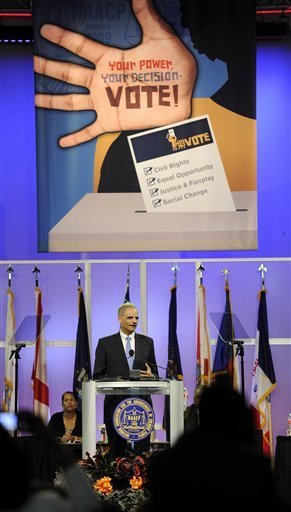
Attorney General Holder spoke at the NAACP Annual Convention in Houston,
Texas today. During his speech he spoke of many things including how
important the work of historical visionary leaders and organizations like the
NAACP has been to our country. What the
Attorney General is getting the most attention for, however is for comparing the new proposed voter id
laws in Texas to poll taxes:
“Many of those without IDs would have to
travel great distances to get them and some would struggle to pay for the
documents they might need to obtain them...We call those poll taxes.”
About Poll Taxes: In the United States, poll taxes were used as a
voting prerequisite in the Southern states. The Populists, a low-income
farmers’ party, gave the Democrats in these areas the only serious competition
that they had experienced since the end of Reconstruction. The intensity of
competition led both parties to bring blacks back into politics and to compete
for their vote. Once the Populists had been defeated, the Democrats amended their
state constitutions or drafted new ones to include various disfranchising
devices. When payment of the poll tax was made a prerequisite to voting,
impoverished blacks and often poor whites, unable to afford the tax, were
denied the right to vote. Poll taxes of
varying stipulations lingered in Southern states into the 20th century. Some
states abolished the tax in the years after World War I, while others retained
it. Its use was declared unconstitutional in federal elections by the
Twenty-fourth Amendment to the U.S. Constitution, effective in 1964. In
1966 the Supreme Court, going beyond the Twenty-fourth Amendment, ruled that
under the “equal protection” clause of the Fourteenth Amendment, states could
not levy a poll tax as a prerequisite for voting in state and local elections.
His entire speech can be found here:
http://www.justice.gov/iso/opa/ag/speeches/2012/ag-speech-120710.html
Thank you, Leon, for those kind words – and thank you all for such a warm welcome. It’s a privilege – and a sincere pleasure – to be with you; to be part another important NAACP gathering; and to share the stage with so many good friends, dedicated partners, and indispensible leaders.
I also want to thank President Jealous, Chairman Brock, General Counsel Keenan, and the NAACP’s National Board of Directors for inviting me to join you. It’s nice to be out of Washington today. And it’s an honor to bring greetings from President Obama, from my fellow members of his Cabinet, and from my colleagues across the United States Department of Justice.
I’m also grateful for this chance to salute the essential work that you are doing – here in the great state of Texas and all across the country – to bring our nation together, and to bring attention to the problems we must solve, the wrongs we must right, the divisions we must heal, and the future we must build. For more than a century, the NAACP’s leaders, members, and supporters have been defined and distinguished by your unyielding determination to do what you believe is right. And I want to tell you how much I appreciate, and am inspired by, the example of strength that this organization continues to provide for our nation – and for me personally.
This convention is focused on issues of real consequence – issues that directly affect people’s lives and influence our nation’s course. So, today – like all of you – I’d like to focus on the future. And I want to discuss some of the ways we must continue to build upon the social, political, economic, educational, and legal progress that this organization – and generations of like-minded civil rights pioneers, activists, advocates, and champions – have struggled and sacrificed to bring about.
Today’s gathering presents an important opportunity to celebrate, and give thanks for, the visionary leaders – from W.E.B. DuBois and Ida B. Wells, to Charles Hamilton Houston, Walter White, Roy Wilkins, Dr. Martin Luther King, Jr., our dear friend John Payton, and Clarence Mitchell, Jr. – whose memory many of you gathered to honor yesterday, and whose critical work – as the NAACP’s Chief Advocate in Washington – is being carried on today, with a renewed spirit and dedication, by Hilary Shelton. This is a critical moment for each of us – not only to lift up their legacies, but to take up the work that became the cause of their lives. And it’s a chance to recommit ourselves, in this hour of need, to the effort that now constitutes our sacred charge, our solemn obligation, and our breathtaking opportunity.
Every one of us has the ability – and, I believe, the responsibility – to continue the work that has driven the NAACP’s record of achievement. In short, it is time – yet again – to put our energy and skills to good use – in advocating for the most vulnerable members of society; in protecting the liberty – and the sacred rights – of every single person in this country; in safeguarding the basic infrastructure of our democracy; in ensuring economic and educational opportunities for all of our countrymen – and women; and in carrying forward the fundamental and inclusive ideals upon which this country was founded, and which continue to drive our pursuit of a more perfect Union.
These were the values that a group of patriots first seized upon 236 years ago last week, when they gathered in Philadelphia to draft a declaration that shook the foundations of an empire and set in motion the great American experiment with which we are entrusted today. They are the principles that another generation fought and died to extend, less than a hundred years later, with the abolition of slavery in the aftermath of a terrible Civil War that remade our nation; and the ratification – exactly 144 years ago this week – of the Fourteenth Amendment to the U.S. Constitution, which finally ensured due process, equal protection, and – for the first time – the full rights of citizenship for the African-American people who helped to build this nation and their heirs. Even within our own lifetimes, these are the essential ideals that have driven great leaders and ordinary citizens alike to stand up, to march forward, to reach out a hand, or simply to take a seat – at a lunch counter or the front of a bus, in a classroom or a courthouse – in order to bring about transformative, once-unimaginable progress.
One of these people was a brave young woman who – in her desire to attend her state’s public university, had to march past a defiant Governor George Wallace to integrate the University of Alabama. I am proud to say that this courageous young student, Vivian Malone, would later become my sister in law. In her pursuit of the educational opportunity she deserved, Vivian was represented by the legendary civil rights attorney – and former NAACP counsel – Fred Gray. With his assistance – and with support from organizations like yours, and with the backing of the Justice Department I now have the privilege to lead, Vivian was able to open new doors of opportunity. And, although she is no longer with us, her legacy continues to teach and inspire us.
If she were here with us this afternoon, I’m certain that Vivian would be proud to help celebrate how far our nation has traveled on the road to equality in the decades since she took her rightful place in that university classroom. But she’d also be the first to remind us that we still have much more to do; and that, despite the advances we’ve seen – and the fact that a direct beneficiary of the civil rights movement now sits in the Oval Office, and another has the honor of addressing you today as the 82nd Attorney General of the United States – our nation’s long struggle for freedom and fairness is far from over. In fact, much of the hardest work remains unfinished. And, for all the successes we’ve enjoyed and the milestones we’ve celebrated – today, in 2012 – we cannot, and we must not, ignore the fact that there are still neighborhoods in America’s most vibrant cities where too many kids go to prison, and too few to college; where our young people are involved in, and become victims of, violence; and where the doors to education and opportunity still seem closed. And there is too little outrage, and not nearly enough action, in response to the fact that – nationwide – homicide is the leading cause of death for black men between the ages of 15 and 24; and that more than 60 percent of young people of all races are exposed to violence at some point in their lives, either as victims or as witnesses – which can have devastating, long-term consequences that last well into adulthood.
This is unacceptable. And it’s why the leadership of organizations like the NAACP – and the engagement of activists throughout Texas and across the country – remains as vital as ever. It’s also why, under the Obama Administration, today’s Justice Department has made an unprecedented commitment to protecting the safety – and potential – of our children.
Through our landmark Defending Childhood Initiative and our National Forum on Youth Violence Prevention, we’re developing strategies for reducing violence and countering its negative impact. I’m especially proud that, for the first time in history, the Department is now directing significant resources for the express purpose of addressing childhood exposure to violence, raising awareness of its ramifications, and advancing scientific inquiry on its causes and characteristics. We’re working closely with other federal agencies, educators, and state and local partners across the country to disrupt the “school to prison pipeline” that transforms too many of our schools from doorways to opportunity into gateways to the correctional system. And this is only the beginning.
At every level of this Administration, we’re working in new ways – and with a range of partners – to achieve fairness and expand opportunity – from successfully advocating for the reduction of the unjust 100-to-1 sentencing disparity between crack and powder cocaine offenses, to launching a new emphasis on re-entry programs to ensure the successful reintegration into society of those who have become involved in the criminal justice system. Through the Justice Department’s new Access to Justice Office, we’re fighting to expand the availability of desperately needed legal services, and to advance pro bono initiatives – in both the public and private sectors – that can help provide representation for those who can’t afford it. And, by any measure, our determination to build on these efforts – particularly through the work of the Department’s Civil Rights Division – has, quite simply, never been stronger.
As Attorney General, I am often mindful of the fact that I have the great privilege – and the solemn duty – of overseeing the enforcement of many of the laws and reforms that the NAACP fought so hard to enact. I take this obligation seriously. It is at the forefront of all I do as Attorney General. For the Department I lead – and our allies across the country – this work is a top priority. And our approach has never been more effective.
Over the past three years, the Civil Rights Division has filed more criminal civil rights cases than ever before, including record numbers of police misconduct, hate crimes, and human trafficking cases. We’ve moved aggressively to combat continuing racial segregation in our schools – and to eliminate discriminatory practices in our housing and lending markets, where we recently achieved the largest residential fair lending settlement in American history. We’ve also worked to eliminate bias, combat intimidation, and ensure nothing but the highest standards of integrity and professionalism across our nation’s law enforcement community. And – alongside state, local, tribal, and international authorities – we’ve reinvigorated sweeping efforts to ensure that, in our workplaces and military bases; in our classrooms and places of worship; in our immigrant communities and our voting booths – the rights of all Americans are protected.
Nowhere is this clearer than in our work to combat hate crimes, and to bring those who commit these vicious acts to justice. Over the past three years, the Justice Department prosecuted 35 percent more hate crime cases than during the preceding three-year period. We’ve moved vigorously to enforce the landmark Matthew Shepard and James Byrd, Jr. Hate Crimes Prevention Act – which the NAACP strongly supported, and which President Obama signed into law in 2009. And we’re working to bring together a range of allies and partners to help strengthen our collaborative efforts to make good on the promise of equal justice – and the protections of our legal system – in every sector of society.
At a fundamental level, this is the same commitment that has driven us to expand access to, and prevent discrimination in, America’s elections systems. And in jurisdictions across the country, it has compelled the Civil Right’s Division’s Voting Section to take meaningful steps to ensure integrity, independence, and transparency in our enforcement of the Voting Rights Act of 1965 – a law that the NAACP was instrumental in advancing.
Especially in recent months, Texas has – in many ways – been at the center of our national debate about voting rights issues. And I know many of you have been on the front lines of this fight. Here – as in a number of jurisdictions across the country – the Justice Department has initiated careful, thorough, and independent reviews of proposed voting changes – including redistricting plans, early voting procedures, photo identification requirements, and changes affecting third party registration organizations – in order to guard against disenfranchisement, and to help ensure that none of these proposals would have a discriminatory purpose or effect.
And, as many of you know, yesterday was the first day of trial in a case that the State of Texas filed against the Justice Department, under Section 5 of the Voting Rights Act, seeking approval of its proposed voter ID law. After close review, the Department found that this law would be harmful to minority voters – and we rejected its implementation.
Under the proposed law, concealed handgun licenses would be acceptable forms of photo ID – but student IDs would not. Many of those without IDs would have to travel great distances to get them – and some would struggle to pay for the documents they might need to obtain them. Since the passage of this law, the NAACP and other leading civil rights organizations have been spearheading critical efforts to protect the rights of minority voters in this and other states. And a growing number of you are working to raise awareness about the potential impact of this and other similar laws – and the fact that – according to some recent studies – nationally, only 8% of white voting age citizens, while 25% of African-American voting age citizens, lack a government-issued photo ID. In our efforts to protect voting rights and to prevent voting fraud, we will be vigilant and strong. But let me be clear: we will not allow political pretexts to disenfranchise American citizens of their most precious right.
Now, I can’t predict the future. And I don’t know what will happen as this case moves forward. But I can assure you that the Justice Department’s efforts to uphold and enforce voting rights will remain aggressive. And I have every expectation that we’ll continue to be effective. The arc of American history has always moved toward expanding the electorate. It is what has made this nation exceptional. We will simply not allow this era to be the beginning of the reversal of that historic progress,
For this and other reasons, I am confident about where this work will lead us – and the progress that passionate advocates like all of you will continue to make possible. And as we carry these efforts into the future, there’s no question that we’ll keep relying on organizations like the NAACP to help extend essential protections – and to encourage broad-based engagement – on a host of other issues of national concern.
I’m sure that, like millions of others across the country, you were closely following last month’s decisions by the Supreme Court – to strike down major provisions of an Arizona law that would have effectively criminalized unlawful status, and to uphold essential components of the Affordable Care Act. As President Jealous and Chairman Brock noted, these monumental rulings constituted an important step forward – providing a clear and final decision on a landmark health care law that will offer desperately needed help to millions of Americans, and – in the Arizona decision – confirming the federal government’s exclusive authority to regulate on immigration issues, so that our nation speaks with one voice in this important area.
I’m pleased that, in both cases, the Court broadly affirmed the government’s position as argued by the Justice Department. However, I remain concerned about the practical impact of the remaining provision of the Arizona law that requires local law enforcement officials to check the immigration status of anyone they even suspect to be here illegally. No American should ever live under a cloud of suspicion just because of what they look like. Going forward, we must ensure that Arizona law enforcement officials do not enforce this law in a manner that undermines the civil rights of Americans. In this work, I can assure you that the Department of Justice will continue to be vigilant.
At the same time, I recognize that the Justice Department will never be able to do it all – and that it simply won’t be possible for government to make all of the progress we need, and that the American people deserve, on our own.
So, this afternoon, as we come together to celebrate the power of individual voices, and the strength of collective action – we must also take stock of what’s left to do, and reflect on the responsibilities that each one of us shares – to ourselves, to those whose memories we honor this week, and – of course – to our children. Although the direction we must take is clear, the road ahead is far from certain. Significant obstacles and unprecedented threats remain to be confronted. And overcoming these challenges is sure to be anything but easy.
But I firmly believe that – if the leaders in this room heed the lessons of our past and follow the examples of our predecessors; if we keep faith in one another, and in our democratic institutions; and if we rededicate ourselves to the essential work of helping freedom grow, and extending the blessings of our Constitution to all men and women – there is no limit to the progress we can make, or the distance we must – and will – travel together in the days ahead.
Once again, thank you for your commitment to – and leadership of – this work. May God continue to bless our journey. And may God continue to bless the United States of America.