Showing posts with label today in african-american history. Show all posts

Thursday, January 9, 2025

Scholarship, Conventions and Brotherhood

Today in Black History....

In 1866, Fisk University opened for classes in Nashville, Tennessee. Barely six months after the end of the Civil War and just two years after the Emancipation Proclamation, three men - John Ogden, the Reverend Erastus Milo Cravath, and the Reverend Edward P. Smith - established the Fisk School in Nashville, name in honor of General Clinton B. Fisk of the Tennessee Freedmens Bureau, an abolitionist who helped establish the first free public schools in the south for white AND African-American children. General Fisk also provided the new institution with facilities in former Union Army barracks near the present site of Nashvilles Union Station. In 1954, Fisk became the first private black college accredited for its music programs by the National Association of Schools of Music. 

Famous Fisk alumni include Johnetta B. Cole, Mayor Marion Barry, John Hope Franklin, WEB DuBois, Congressman John Lewis, Nikki Giovani and Ida B. Wells.


In 1873, Delaware's Convention of Colored People convened in Dover to demand equal educational opportunities. The delegates adopted a powerful resolution condemning schooling discrimination: "From our population of over twenty thousand souls, or nearly one-fifth the entire population of the State, the Legislature does not provide a solitary school, nor appropriate a single dollar of State money. We hold this discrimination as against the genius of government; insulting to the laws of Congress; detrimental to the best interests of the State, and outrageous to the colored tax payers."This convention was part of the larger Colored Conventions Movement, which ran from 1830 to 1888. These gatherings of Black leaders and citizens addressed crucial issues like education, labor rights, and civil liberties, highlighting Black agency and organizational power in the fight for equality


In 1914, Phi Beta Sigma was founded at Howard University in Washington, DC. by three young African-American male students - A. Langston Taylor, Leonard F. Morse and Charles I. Brown. The founders wanted to organize a Greek letter fraternity that would exemplify the ideals of brotherhood, scholarship and service. the fraternity is the only one of its kind to aid in the creation and hold a consitutional bond with a African-American sorority. The Founders wanted its organization to be a part of the community as opposed to apart from the community. Their deep conviction for community service is embodied in its motto, "Culture for Service and Service for Humanity."


http://en.wikipedia.org/wiki/Clinton_B._Fisk 
http://www.fisk.edu/
http://www.pbs1914.org/history/
http://en.wikipedia.org/wiki/Phi_Beta_Sigma https://www.zinnedproject.org/news/tdih/convention-of-colored-people-discuss-education/

Saturday, August 31, 2013

August in Black History

Each month we'll list daily black history notes for the month.  Here's what happened in August in Black History.

On August 31 in Black History...
Pigeon Point in Tobago
In 1962, Trinidad-Tobago proclaimed independence. The Republic of Trinidad and Tobago is an archipelagic state in the southern Caribbean, lying just off the coast of northeastern Venezuela and south of Grenada in the Lesser Antilles. It shares maritime boundaries with other nations including Barbados to the northeast, Guyana to the southeast, and Venezuela to the south and west. Trinidad and Tobago is known for its Carnival and is the birthplace of steelpan, calypso, soca, and limbo.
Trinidad and Tobago gained its independence from the United Kingdom in 1962. The presence of American military bases in Chaguaramas and Cumuto in Trinidad during World War II profoundly changed the character of society. In the post-war period, the wave of decolonisation that swept the British Empire led to the formation of the West Indies Federation in 1958 as a vehicle for independence. Chaguaramas was the proposed site for the federal capital. The Federation dissolved after the withdrawal of Jamaica and the government chose to seek independence on its own.[citation needed]
In 1976, the country severed its links with the British monarchy and became a republic within the Commonwealth, though it retained the British Privy Council as its final Court of Appeal. Between the years 1972 and 1983, the Republic profited greatly from the rising price of oil, as the oil-rich country increased its living standards greatly. In 1990, 114 members of the Jamaat al Muslimeen, led by Yasin Abu Bakr, formerly known as Lennox Phillip, stormed the Red House (the seat of Parliament), and Trinidad and Tobago Television, the only television station in the country at the time, and held the country's government hostage for six days before surrendering. Since 2003, the country has entered a second oil boom, a driving force which the government hopes to use to turn the country's main export back to sugar and agriculture.[citation needed] Great concern was raised in August 2007 when it was predicted that this boom would last only until 2018. Petroleum, petrochemicals and natural gas continue to be the backbone of the economy. Tourism and the public service are the mainstay of the economy of Tobago, though authorities have begun to diversify the island. The bulk of tourism visitor arrival on the islands are from Western Europe.http://en.wikipedia.org/wiki/Trinidad_and_Tobago#Independence

Thomas M. Gregory
In 1879, Livingstone College was founded in Salisbury, North Carolina, began as an educational institution for clergy in the African Methodist Church (A.M.E.). It was located in a small house on seven acres of land donated by the Reverend Thurber, and was called Zion Wesley Institute. Livingstone is a coeducational, residential, church-related college located in Salisbury, N.C., largely supported by the African Methodist Episcopal Zion Church. The college consists of two schools: an undergraduate College of Arts and Sciences and a graduate school of theology named Hood Theological Seminary.   http://www.aaregistry.org/historic_events/view/livingstone-college-founded-north-carolina
In 1887, Thomas Montgomery Gregory was born in Washington, DC.  He was an African American dramatist, educator, social philosopher, and activist.  http://www.aaregistry.org/historic_events/view/thomas-montgomery-gregory-broke-ground-black-theaterIn 1842, Josephine St. Pierre Ruffin, a Black journalist and civil rights leader, was born.  http://www.aaregistry.org/historic_events/view/josephine-ruffin-activist-philanthropist-and-newspaper-publisher
In 1935, Frank Robinson, first black manager in major league baseball was born in Beaumont, Texas.
In 1979, Donald McHenry named to succeed Andrew Young as UN.


On August 30 in Black History...
Roy Wilkins at the White House in 1868
In 1966, Constance Baker Motley was confirmed as U.S. district judge and became the first Black woman on the federal bench.
In 1983, Lt. Col. Guion S. Bluford Jr. became the first Black US astronaut enters space.
In 1881, W.S. Campbell patents improved, self-setting animal trap.
In 1843, Blacks participated in a national political convention for the first time at Liberty party convention in Buffalo, New York.

In 1901, Roy Wilkins was born in St. Louis, Missouri. Wilkins was a prominent civil rights activist from the 1930s to the 1970s. Wilkins' most notable role was in his leadership of the National Association for the Advancement of Colored People (NAACP).  In 1955, Roy Wilkins was chosen to be the executive secretary of the NAACP and in 1964 he became its executive director. He had an excellent reputation as a spokesperson for the civil rights movement. One of his first actions was to provide support to civil rights activists in Mississippi who were being subject to a "credit squeeze" by members of the White Citizens Councils. http://en.wikipedia.org/wiki/Roy_Wilkins
In 1936, Buddy Guy, influential blues guitarist and singer was born in Lettsworth, LA, USA. His most popular records include "First Time I Met The Blues" and "Stone Crazy".  http://en.wikipedia.org/wiki/Buddy_guy

On August 29 in Black History...
In 1957, Congress passed the Civil Rights Act of 1957, the first federal civil rights legislation since 1875. The bill established a civil rights commission and a civil rights division in the Justice Department. It also gave the Justice Department authority to seek injunctions against voting rights infractions.
In 1962, Mal Goode becomes the first African American television news commentator when he begins broadcasting on ABC.
In 1894, Sociologist ,E. Franklin Frasier was born. 
In 1924, Dinah Washington was born. 
In 1920, Jazz musician, Charlie "Bird" Parker was born in Kansas City. 
In 1958 Michael Jackson was born.

On August 28 in Black History...
In 1963, Martin Luther King Jr gives his "I Have A Dream" speech at the Lincoln Memorial.  http://experiencinghistory.blogspot.com/2011/08/i-have-dream.html

On August 20 in Black History...
In 1989 - The first National Black Theater Festival closes in Winston-Salem, N.C.
In 1964 - President Johnson signed Economic Opportunity Act
In 1944, Spingarn Medal presented to Charles R. Drew "who set up and ran the blood plasma bank in the Presbyterian Hospital in New York City which served as one of the models for the widespread system of blood banks now in operation for the American Red Cross."
In 1941, William Herbert Gray, III (Bill Gray) was born on this day.
In  1939, The National Negro Bowling Association was organized in Detroit, Michigan and Wynston Brown became its first president.
In 1856 - Wilberforce University was established in Ohio.
In 1831, Nat Turner, a brilliant minister and moody slave, led the first slave revolt of magnitude. The revolt was crushed, but only after Turner and his band had killed some sixty whites and threw the South into panic. After hiding out, Turner was captured on October 30...
In 1830 - First National Negro Convention took place in Philadelphia, chaired by Richard.
In 1619 -Twenty Africans arrived in Jamestown, Virginia, aboard a Dutch ship. They are the first blacks to be forcibly settled as involuntary laborers in the North American British Colonies.


On August 19 in Black History...

1989 - Desmond Tutu defied apartheid laws by walking alone on a South African beach.
In 1958, youth from the NAACP Council begins sit-ins at lunch counters in Oklahoma City. The Dockum Drug Store sit-in was one of the first organized lunch-counter sit-ins for the purpose of integrating segregated establishments in the United States. The protest began in July 1958 in Wichita, Kansas at the Dockum Drug Store, a store in the old Rexall chain, in which protesters would sit at the counter all day until the store closed, ignoring taunts from counter protesters. The sit-in ended three weeks later when the owner relented and agreed to serve black patrons.

Twenty-year-old Ron Walters, president of the local NAACP Youth Council, organized the Wichita protest together with his cousin Carol Parks-Hahn. Wichita was heavily segregated in the late 1950s, with schools segregated up to high school and blacks excluded from public accommodations. While working at a job in downtown Wichita, Walters went for lunch to a Woolworth's store, which would only serve blacks bagged lunches sold from one end of the lunch counter. Seeking to find a way to protest against the practice, Walters and his cousin Carol Parks-Hahn met with attorney Frank Williams, who described a sit-in by students at a California college who ended segregation at a campus restaurant by occupying it with students reading newspapers all day long. The protest was inspired by the actions of the Little Rock Nine and the earlier Montgomery Bus Boycott. The plan they developed targeted Dockum, a downtown store that was part of the national Rexall chain, which had a lunch counter that only served white customers, starting on July 19, 1958, with ten well-dressed and polite students seeking to place orders while sitting at the lunch counter. Parks-Haun ordered a Coca-Cola from a waitress, who served it to her but then pulled it back when she realized that "store policy was not to serve colored people". Students sat quietly all day at the counters, enduring taunts and threats from white customers. After three weeks, in early August, the manager came in and said "Serve them — I'm losing too much money". Historian Gretchen Eick called the Dockum Drug Store sit-in as setting "a precedent that really began what would be a very significant strategy — a strategy that would change the way business was done in the United States". Ultimately, all of the Dockum locations in Kansas were desegregated.

Though the Dockum sit-in had attracted little media attention, on August 19, 1958 in Oklahoma City a nationally recognized sit-in at the Katz Drug Store lunch counter occurred. The protest there was led by NAACP Youth Council leader Clara Luper, a local high school teacher, together with young local students, including Luper's eight-year old daughter, who had suggested the sit-in be held. The group quickly desegregated the Katz Drug Store lunch counters. Following the Oklahoma City sit-ins, the tactic of non-violent student sit-ins spread. The widely publicized Greensboro sit-ins began more than a year later at a Woolworth's in Greensboro, North Carolina, starting on February 1, 1960, launching a wave of anti-segregation sit-ins across the South and opened a national awareness of the depth of segregation in the nation.

A 20-foot-long bronze sculpture first announced in 1998 at a cost of $3 million marks the site of the successful sit-in, with a lunch counter and patrons depicting the protest.
http://en.wikipedia.org/wiki/Dockum_Drug_Store_sit-in
http://www.thehistorymakers.com/biography/biography.asp?bioindex=627&category=educationMakers

In 1791 - Benjamin Banneker writes letter to then secretary of state Thomas Jefferson. The letter showed the hypocrisy of slavery. After departing the federal capital area, Banneker wrote a letter to Thomas Jefferson, who in 1776 had drafted the United States Declaration of Independence and in 1791 was serving as the United States Secretary of State. Quoting language in the Declaration, the letter expressed a plea for justice for African Americans. To further support this plea, Banneker included within the letter a handwritten manuscript of an almanac for 1792 containing his ephemeris with his astronomical calculations. In the letter, Banneker accused Jefferson of criminally using fraud and violence to oppress his slaves by stating:

“…Sir, how pitiable is it to reflect, that although you were so fully convinced of the benevolence of the Father of Mankind, and of his equal and impartial distribution of these rights and privileges, which he hath conferred upon them, that you should at the same time counteract his mercies, in detaining by fraud and violence so numerous a part of my brethren, under groaning captivity and cruel oppression, that you should at the same time be found guilty of that most criminal act, which you professedly detested in others, with respect to yourselves.”
http://en.wikipedia.org/wiki/Benjamin_Banneker#Letter_to_Thomas_Jefferson_on_racism


On August 18 in Black History...
In 1963, James Meredith, the first Black person admitted to the University of Mississippi, graduates from University of Mississippi, 1963.  James H. Meredith (born June 25, 1933) is an American civil rights movement figure. He was the first African American student at the University of Mississippi, an event that was a flashpoint in the American civil rights movement. Motivated by the broadcast of President John F. Kennedy's inaugural address (which did not mention civil rights per se). Meredith decided to exercise his democratic rights and apply to the University of Mississippi. Meredith's goal was to put pressure on the Kennedy administration as to the issue.  Meredith was married to Mary June Wiggins Meredith, now deceased.They had one daughter, Jessica Meredith Knight, and three sons: James, John and Joseph Howard Meredith. In 1989, the junior James Meredith (then 20) was sentenced to one year's house arrest for his role in a 1987 car crash in which two of his co-workers were killed and he suffered serious injuries. In 2002, Joseph Meredith graduated from the University of Mississippi as the most outstanding doctoral student in the School of Business Administration. Joseph had previously earned degrees from Harvard University and Millsaps College. James Meredith said of the occasion, "I think there's no better proof that White supremacy was wrong than not only to have my son graduate, but to graduate as the most outstanding graduate of the school...That, I think, vindicates my whole life." Joseph Meredith died in 2008 at age 39 of complications from lupus. At the time of his death, he was an assistant professor of finance at Texas A&M International University. He left behind a daughter, Jasmine Victoria. James Meredith currently lives in Jackson, Mississippi with his second wife, Judy Alsobrook Meredith. Meredith wrote a memoir of his days at the University of Mississippi entitled Three Years in Mississippi, published by the Indiana University Press in 1966, and also self-published several books.


On August 14 in Black History...

In 1883, Biologist and pioneer of cell division, Ernest E. Just was born.  Just was a pioneering African American biologist, academic and science writer. Just's primary legacy is his recognition of the fundamental role of the cell surface in the development of organisms. In his work within marine biology, cytology and parthenogenesis, he advocated the study of whole cells under normal conditions, rather than simply breaking them apart in a laboratory setting. Ernest also assisted three Howard students (Edgar Amos Love, Oscar James Cooper, and Frank Coleman), in establishing Omega Psi Phi Fraternity, Inc. Just was the subject of the 1983 biography Black Apollo of Science: The Life of Ernest Everett Just by Kenneth R. Manning. The book received the 1983 Pfizer Award and was a finalist for the 1984 Pulitzer Prizefor Biography or Autobiography

In 1968, Halle Berry was born.  Berry is an American actress, former fashion model, and beauty queen. Berry received an Emmy, Golden Globe, SAG, and an NAACP Image Award for Introducing Dorothy Dandridge and won an Academy Award for Best Actress and was nominated for a BAFTA Award in 2001 for her performance in Monster's Ball, becoming the first and, as of 2011, only woman of African American descent to have won the award for Best Actress. She is one of the most highly paid actresses in Hollywood and also a Revlon spokeswoman. She has been involved in the production side of several of the films in which she performed.  Before becoming an actress, Berry entered several beauty contests, finishing as the 1st runner-up in the Miss USA Pageant (1986), and coming in 6th place in the Miss World Pageant in 1986. She made her film debut with a small role in 1991's Jungle Fever. This led to starring roles in The Flintstones (1994), Bulworth (1998), X-Men (2000) and its sequels, and as Bond Girl Jinx in Die Another Day (2002). She also won the Golden Raspberry Award for Worst Actress in 2005 for Catwoman and accepted the award in person—one of the few performers to do so.

In 1959, Ervin "Magic" Johnson was born.  Johnson Jr. is a retired American professional basketball player who played point guard for the Los Angeles Lakers of the National Basketball Association (NBA). After winning championships in high school and college, Johnson was selected first overall in the 1979 NBA Draft by the Lakers. He won a championship and an NBA Finals Most Valuable Player Award in his rookie season, and won four more championships with the Lakers during the 1980s. Johnson retired abruptly in 1991 after announcing that he had contracted HIV, but returned to play in the 1992 All-Star Game, winning the All-Star MVP Award. After protests from his fellow players, he retired again for four years, but returned in 1996, at age 37, to play 32 games for the Lakers before retiring for the third and final time.  http://en.wikipedia.org/wiki/Magic_Johnson

In 1914, Dr. Herman Branson, physicist and chemist, was born in Pocohantas, Virginia. Branson was an African-American physicist, best known for his research on the alpha helix protein structure, and was also the president of two colleges.

On August 13 in Black History...
Dr. Charles Anderson
In 1919, Meteorologist, Charles Edward Anderson, PhD was born in St. Louis, Missouri.  Charles E. Anderson earned a bachelor of science degree in Chemistry in 1941 from Lincoln University and received high accolades as he graduated third in his class. Lincoln University was also the place where he met his wife-to-be, Marjorie Anderson. Upon graduating, World War II had begun and enlisted in U.S. Army Air Forces.He was assigned to the meteorology division and Anderson claims that this came about due to the process of elimination. The Army sent him, along with 150 other cadets to the University of Chicago to study meteorology. While there along with an exceptionally heavy academic course load, Anderson also underwent physical training, weapons training, and specific training in military intelligence. Anderson completed this training in May 1943 and earned his meteorological certification. Upon finishing, he was stationed in Tuskegee, Alabama where he was assigned as a weather officer for the 332nd Fighter Group now known as the Tuskegee Airmen.
After his service in Tuskegee, Anderson became a squadron weather officer and trained fighter pilots across the country. Anderson temporarily left the Army Air Corps after the war to pursue an opportunity in high polymer chemistry at the Polytechnic Institute of Brooklyn in 1946. After receiving his Master's Degree, Anderson became a research and development officer for Watson Laboratories, supervising the works of many notable German scientists. In 1955, Anderson decided to further pursue his academic studies and applied to the doctoral program in Meteorology at the Massachusetts Institute of Technology. During this time he wrote his dissertation: "A Study of the Pulsating Growth of Cumulus Clouds." Anderson earned his Ph.D. in 1960, becoming the first African American to earn a Ph.D. in Meteorology.  http://en.wikipedia.org/wiki/Charles_E._Anderson
http://www.aaregistry.org/historic_events/view/charles-anderson-scientist-born

On August 5 in Black History...

In 1962, Patrick Ewing was born in Kingston, Jamaica.  He played most of his career with the NBA's New York Knicks as their starting center and played briefly with the Seattle SuperSonics andOrlando Magic. Ewing was named as the 16th greatest college player of all time by ESPN. He won Olympic Gold Medals as a member of the 1984 and 1992 US Men's National Basketball teams. In a 1996 poll celebrating the 50th anniversary of the NBA, Ewing was selected as one of the 50 Greatest Basketball Players of All Time. On April 7, 2008 he was elected to the Basketball Hall of Fame in Springfield, Massachusetts. He was inducted into the Hall of Fame on September 5, 2008 along with former NBA coach Pat Riley and former Houston Rockets center, Hakeem Olajuwon. His number 33 was retired by the Knicks in 2003.  


Check out these sites are where I get many of the daily black history info: http://www.blackfacts.com/ http://www.dayinblackhistory.com/

Tuesday, August 6, 2013

Voting Rights Act is Signed Into Law

Today in Black History....

In 1965, President Lyndon Johnson signed the Voting Rights Act into law with Martin Luther King, Jr. and Rosa Parks in attendance.
Dr. King and President Johnson


Today, 48 years later the country has come a long way....and the journey to voter discrimination still is not over. Just this year the Supreme Court decided to strike down a central part of the landmark law.

What does this mean for us????  This means we have to work harder than ever to get out the vote and work in our local communities to ensure that we get our right to vote AND exercise it!


About the Voting Rights Act...
The Voting Rights Act of 1965 (42 U.S.C. §§ 19731973aa-6)[2] is a landmark piece of national legislation in the United States that prohibits discrimination in voting.[3] Echoing the language of the 15th Amendment, the Act prohibits states and local governments from imposing any "voting qualification or prerequisite to voting, or standard, practice, or procedure ... to deny or abridge the right of any citizen of the United States to vote on account of race or color."[4] Specifically, Congress intended the Act to outlaw the practice of requiring otherwise qualified voters to pass literacy tests in order to register to vote, a principal means by which Southern states had preventedAfrican Americans from exercising the franchise.[3] The Act was signed into law by President Lyndon B. Johnson, who had earlier signed the landmark Civil Rights Act of 1964 into law.  Read more here:  http://en.wikipedia.org/wiki/Voting_Rights_Act_of_1965

Tuesday, April 30, 2013

April in Black History

Today in Black History

Each month we'll list daily black history notes for the month.  Here's what happened in April in Black History:


On April 27 in Black History Month…
In 1882, Jesse Redmon Fauset was born in Snow Hill, NJ. She was an African American novelist, critic, poet, and editor known for her discovery and encouragement of several writers of the Harlem Renaissance.
http://experiencinghistory.blogspot.com/2011/01/eh-january-2011-spotlight-each-month-eh.html


On April 16 in Black History Month…
In 1924, Don Redman performed the first recorded scat vocals while a member of Fletcher Henderson's Orchestra. Scat singing is an improvised vocal instrumentation composed of nonsense syllables. Don Redman scatted a few bars of "My Papa Doesn't Two-Time No Time," recorded in New York by Columbia. Although Louis Armstrong is generally credited with having recorded the first scat vocals, Don Redman actually preceded him by two years.  http://experiencinghistory.blogspot.com/2012/04/scatgiving-songs-flavor.html


On April 14 in Black History Month…
In 1924, Robert Mugabe was born. He is an African politician and revolutionary leader and president of Zimbabwe. An educator by trade and a politician by practice, Mugabe has been the preeminent political leader in Zimbabwe for nearly two decades.  http://www.aaregistry.org/historic_events/view/robert-mugabe-typical-politician
"Jug" Gene Ammons
In 1873, the Slaughterhouse cases were decided by the Supreme Court. These had a profound affect on former Black slaves and the Fourteenth Amendment of the American Constitution. Read more here:http://www.aaregistry.org/historic_events/view/supreme-court-rules-slaughterhouse-cases
In1955, Elston Howard became the first Black man to play for the New York Yankees baseball team.
In 2002, Tiger Woods won his third master golf tournament.
In 1925, Saxophonist Gene "Jug" Ammons was born. Known by his nickname Jug, Ammons was the son of boogie-woogie pianist Albert Ammons. The younger Ammons worked with the big band of Billy Eckstine from 1944 through 1947. At that time the band included most of the great boppers of the time (Charlie Parker, Dexter Gordon, Sonny Stitt, Dizzy Gillespie, Miles Davis, Fats Navarro and Art Blakey).


On April 2 in Black History Month…
In 1918, Artist Charles White was born in Chicago, IL.

On April 1 in Black History…


In 1905, Clara McBride Hale was born in Elizabeth City, North Carolina. Hale founded Hale House, a home for infant children of drug addicts located in Harlem, NY. By 1991, Hale House cared for approximately 1,000 infants and toddlers. During her distinguished career, Hale received numerous honors and awards for her community service. She received an honorary doctorate from John Jay College of Criminal Justice and public service awards from the National Mother’s Day Committee and the Truman Award for Public Service. In 1985, during his State of the Union Address, President Ronald Reagan referred to Hale as an “American hero” for her commitment to at-risk children.The Hale House continues taking care of children today.  http://halehouse.org/?page=home  Read more here:  


Check out these sites are where I get many of the daily black history info: 
http://www.blackpast.org
http://www.blackfacts.com/ 
http://www.dayinblackhistory.com/
http://www.wikipedia.org

Thursday, April 25, 2013

Happy Birthday Ella Fitzgerald!

Ella Fitzgerald
"Just don't give up trying to do what you really want to do. Where there is love and inspiration, I don't think you can go wrong."
Ella Fitzgerald


Today in Black History....

In 1917, the First Lady of Jazz, Ella Fitzgerald was born in Newport News, Virginia. 

Here is Ella singing a few of my favorite Ella songs...


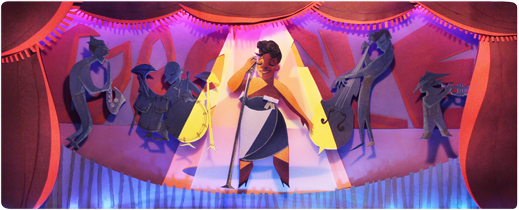
Today Google is commemorating Ella Fitzgerald's 96th birthday with it's Google doodle on its homepage. The doodle shows Ella, also known as 'Queen of Jazz', 'The First Lady of Song' and 'Lady Ella', performing on stage with a band and 'Google' emblazoned on the backdrop.
Ella Fitzgerald's 96th Birthday


ABOUT ELLA
Dubbed "The First Lady of Song," Ella Fitzgerald was the most popular female jazz singer in the United States for more than half a century. In her lifetime, she won 13 Grammy awards and sold over 40 million albums.
Ella Fitzgerald

"I sing like I feel."
Ella Fitzgerald

Her voice was flexible, wide-ranging, accurate and ageless. She could sing sultry ballads, sweet jazz and imitate every instrument in an orchestra. She worked with all the jazz greats, from Duke Ellington, Count Basie and Nat King Cole, to Frank Sinatra, Dizzy Gillespie and Benny Goodman. (Or rather, some might say all the jazz greats had the pleasure of working with Ella.)

She performed at top venues all over the world, and packed them to the hilt. Her audiences were as diverse as her vocal range. They were rich and poor, made up of all races, all religions and all nationalities. In fact, many of them had just one binding factor in common - they all loved her.
Read more about the life and legacy of Ella Fitzgerald here:
http://www.ellafitzgerald.com/about/biography.html
http://en.wikipedia.org/wiki/Ella_Fitzgerald

Friday, February 1, 2013

Black History Month 2013: At the Crossroads

Happy Black History Month!

The 2013 theme of Black History month is:

At the Crossroads of Freedom and Equality: The Emancipation Proclamation and the March on Washington

Charles Bibbs, Artist
"The year 2013 marks two important anniversaries in the history of African Americans and the United States. On January 1, 1863, the Emancipation Proclamation set the United States on the path of ending slavery. ...In 1963, a century later, America once again stood at the crossroads. Nine years earlier, the U.S. Supreme Court had outlawed racial segregation in public schools, but the nation had not yet committed itself to equality of citizenship. ...On August 28, 1963, hundreds of thousands of Americans, blacks and whites, Jews and gentiles, Protestants and Catholics, marched to the memorial of Abraham Lincoln, the author of the Emancipation Proclamation, in the continuing pursuit of equality of citizenship and self-determination."  
Read the entire summary of this year's theme here:  http://www.asalh.net/docs/2013ExecutiveSummary.pdf
Black History Month, also known as African-American History Month in America, is an annual observance in the United States, Canada, and the United Kingdom for remembrance of important people and events in the history of the African diaspora. It is celebrated annually in the United States and Canada in February[ and the United Kingdom in October.

History of Black History Month
As a Harvard-trained historian, Carter G. Woodson, like W. E. B. Du Bois before him, believed that truth could not be denied and that reason would prevail over prejudice. His hopes to raise awareness of African American's contributions to civilization was realized when he and the organization he founded, the Association for the Study of Negro Life and History (ASNLH), conceived and announced Negro History Week in 1925. The event was first celebrated during a week in February 1926 that encompassed the birthdays of both Abraham Lincoln and Frederick Douglass. The response was overwhelming: Black history clubs sprang up; teachers demanded materials to instruct their pupils; and progressive whites, not simply white scholars and philanthropists, stepped forward to endorse the effort.

Today the celebration of this month continues as a time to remember past trials, celebrate achievements and commit to the future growth of our culture.  It is not intended to exclude any other race or culture, but simply to recognize our own contributions to America and to the world.  We also commit to always include our own history and culture as part of American history and the history of the world.
Carter G. Woodson
"When Carter G. Woodson established Negro History week in 1926, he realized the importance of providing a theme to focus the attention of the public. The intention has never been to dictate or limit the exploration of the Black experience, but to bring to the public's attention important developments that merit emphasis.  For those interested in the study of identity and ideology, an exploration of ASALH's Black History themes is itself instructive. Over the years, the themes reflect changes in how people of African descent in the United States have viewed themselves, the influence of social movements on racial ideologies, and the aspirations of the black community. The changes notwithstanding, the list reveals an overarching continuity in ASALH--our dedication to exploring historical issues of importance to people of African descent and race relations in America." Daryl Michael Scott, Howard University
http://asalh.org/themes_future.html


Monday, January 21, 2013

Today's Moment at the Inauguration

As I watched today's coverage of the inauguration there were many moments that I looked forward to.  There were many moments that I will remember.  The speech, the parade, the moment Michele walked out in her Jason Wu gown.  But in THIS moment, we saw the real President Barack Obama and the man we should be praying for.


Other moments...
President Obama taking his oath of office


President and First Lady Obama greeting onlookers in the parade


The First Family enjoying themselves during the parade


President and First Lady Obama dancing at the inaugural ball

Happy MLK Day!


Today we formally recognize the life contributions of Reverend Martin Luther King, Jr. to the United States of America and to the world.

Martin Luther King, Jr. Day is a United States federal holiday marking the birthday of Rev. Dr. Martin Luther King, Jr. It is observed on the third Monday of January each year, which is around the time of King's birthday, January 15. The floating holiday is similar to holidays set under the Uniform Monday Holiday Act, though the act predated the establishment of Martin Luther King, Jr. Day by 15 years.

The idea of Martin Luther King, Jr. Day as a holiday was promoted by labor unions in contract negotiations.After King's death, United States Representative John Conyers (a Democrat from Michigan) and United States Senator Edward Brooke (a Republican from Massachusetts) introduced a bill in Congress to make King's birthday a national holiday. The bill first came to a vote in the U.S. House of Representatives in 1979. However, it fell five votes short of the number needed for passage. Two of the main arguments mentioned by opponents were that a paid holiday for federal employees would be too expensive, and that a holiday to honor a private citizen would be contrary to longstanding tradition (King had never held public office). Only three other persons have national holidays in the United States honoring them: George Washington, Christopher Columbus, and Jesus.

Soon after, the King Center turned to support from the corporate community and the general public. The success of this strategy was cemented when musician Stevie Wonder released the single "Happy Birthday" to popularize the campaign in 1980 and hosted the Rally for Peace Press Conference in 1981. Six million signatures were collected for a petition to Congress to pass the law, termed by a 2006 article in The Nation as "the largest petition in favor of an issue in U.S. history."


The bill established the Martin Luther King, Jr. Federal Holiday Commission to oversee observance of the holiday, and Coretta Scott King, Martin Luther King Jr.'s wife, was made a member of this commission for life by President George H. W. Bush in May 1989
Pictured left is Coretta Scott King at the Martin Luther King, Jr. Day signing ceremony


This year President Obama issued the annual proclamation of MLK day: http://www.whitehouse.gov/the-press-office/2013/01/18/presidential-proclamation-martin-luther-king-jr-federal-holiday-2013=

Thursday, January 10, 2013

Happy Birthday George Washington Carver!

"It is not the style of clothes one wears, neither the kind of automobile one drives, nor the amount of money one has in the bank, that counts. These mean nothing. It is simply service that measures success."
– George Washington Carver
George Washington Carver
George Washington Carver, scientist, botanist, educator, and inventor. The exact day and year of his birth are unknown; he is believed to have been born into slavery in Missouri in January 1864 so we celebrate the birthday of this great man today.

Carver's reputation is based on his research into and promotion of alternative crops to cotton, such as peanuts, soybeans and sweet potatoes, which also aided nutrition for farm families. He wanted poor farmers to grow alternative crops both as a source of their own food and as a source of other products to improve their quality of life. The most popular of his 44 practical bulletins for farmers contained 105 food recipes using peanuts. He also developed and promoted about 100 products made from peanuts that were useful for the house and farm, including cosmetics, dyes, paints, plastics, gasoline, and nitroglycerin.

He received numerous honors for his work, including the Spingarn Medal of the NAACP.  During the Reconstruction-era South, monoculture of cotton depleted the soil in many areas. In the early 20th century, the boll weevil destroyed much of the cotton crop, and planters and farm workers suffered. Carver's work on peanuts was intended to provide an alternative crop.

Check out this video about Carver here:


Read more about George Washington Carver:
http://en.wikipedia.org/wiki/George_Washington_Carver
http://www.biography.com/people/george-washington-carver-9240299
http://inventors.about.com/od/cstartinventors/a/GWC.htm

Tuesday, January 1, 2013

Creativity and Faith...Happy Kwanzaa


On the 6th day of Kwanzaa we celebrated Kuumba... Creativity.  We are encouraged to do always as much as we can, in the way that we can, in order to leave our community more beautiful and beneficial than when we inherited it.


Today on the 7th and final day of Kwanzaa we celebrate Imani...Faith.  Today we are reminded to believe with all of our heart in our people, our parents, our teachers, our leaders and the righteousness and victory of our struggle.


Find out more about Kwanzaa: http://www.officialkwanzaawebsite.org

Sunday, December 30, 2012

Nia...Purpose


On this 5th day of Kwanzaa we celebrate Nia, Purpose.  This day we focus on making our collective vocation the building and developing of our community in order to restore our people to their traditional greatness.

 Find out more about Kwanzaa: http://www.officialkwanzaawebsite.org

The Kwanzaa candles and harvest
Symbols of Kwanzaa

Saturday, December 29, 2012

Ujamaa... Cooperative Economics

On today this fourth day of Kwanzaa, we celebrate Ujamaa, Cooperative Economics. We are encouraged to build and maintain our own stores, shops and other businesses, and to profit from them together.

In the spirit of Ujamaa, I wanted to highlight a few black owned small businesses that I personally patron across the country.

Virtual Leap
Trinita McCormick, Owner
Raleigh, North Carolina
http://virtualleapvas.com/index.html
Virtual Leap is a virtual administrative professional company where we give you the JUMP on the competition! What is one of the biggest obstacles to overcome in the day of a business owner? They need more time to get everything accomplished! Our primary goal at Virtual LEAP is to free up more TIME in the day of small business owners, entrepreneurs and busy individuals to focus on true revenue generating activity. How do we create more time? We create more time by performing the administrative tasks that while necessary to support the business, do not alone generate profit for the business owner.

The Cookie Lady's Bakery & Cafe
Necola Adams, Owner
Merced, California
https://www.facebook.com/cookieladysbakery
Mrs. Adams is back, creating "COOKIES WITH AN ATTITUDE" as well as delicious lunch menu for dining in or carry out. You can even enjoy our most convenient free delivery service. MRS ADAMS has tried her recipes from MERCED to HOLLYWOOD, serving gourmet & deli delights to family, friends and to the STARS!!

Divine Creations Hair Designs

Kay Owens, CEO and Expert Stylist
Kesalynn Wiley, CFO
Tira Merrick (not the owner but my favorite stylist in the salon:) )
http://www.divinecreationshairdesigns.com
Divine Creations Hair Designs…the dream of two sisters, who turned their vision into reality.
Fifty years ago their grandmother, Lady Eloise, worked hard to open her first salon called Reed's Beauty Salon. It didn't take long for hair to become second nature to eldest sister, Kay, who spent her days growing up in the salon and attained a passion for it. Ten years later, Kay struck out on her own, knowing her younger sister shared the dream of running her own business and had a vision for success. With Kay's experience as an expert stylist and Kesalynn's (Kesa) education as a Finance major, the siblings collaborated and opened Divine Creations Hair Designs. Their goal was to offer unique services, otherwise lacking in other salons and open 7 Days a Week.  Together with each other's expertise, they generated a formula for success. Today, Divine Creations is a viable business ran and managed by Kay Owens, Expert Stylist & CEO and Kesalynn Wiley, middle sister & CFO. Thus, from the hard work of a grandmother, to the dream of sisters, through more hard work and prayer…they turned their vision into reality.

The Kwanzaa candles and harvest
Symbols of Kwanzaa
Find out more about Kwanzaa: http://www.officialkwanzaawebsite.org

Friday, December 28, 2012

Ujima...Collective Work and Responsibility


Today, on the third day of Kwanzaa, reflect on Ujima.

 
UJIMA
Ujima, pronounced "oo-GEE-mah" means Collective Work and Responsibility where we are encouraged to build and maintain our community together and make our brother's and sister's problems our problems and to solve them together.  This day reminds us of our obligation to the past, present and future, and that we have a role to play in the community, society, and world.


The Kwanzaa candles and harvest
Symbols of Kwanzaa

In the Symbols of Kwanzaa picture to the left, the crops are the Mazao which are symbolic of African harvest celebrations and of the rewards of productive and collective labor.


Find out more about Kwanzaa: http://www.officialkwanzaawebsite.org

Thursday, December 27, 2012

Kugichagula....Day of Self-Determination

The Kwanzaa candles and harvest
Symbols of Kwanzaa
Today is the second day of Kwanzaa where we focus on
Kugichagula which is Self-Determination.

In the Symbols of Kwanzaa picture to the right, the candle holder is the Kinara which is symbolic of our roots, our parent people -- continental Africans.


Kugichagula...Day of Self-Determination


Kugichagula, pronounced "koo-jee-cha-goo-LEE-ah" means to define ourselves, name ourselves, create for ourselves, and speak for ourselves.


Find out more about Kwanzaa: http://www.officialkwanzaawebsite.org

Wednesday, December 26, 2012

Umoja...Day of Unity

Happy Kwanzaa!!!

The Kwanzaa candles and harvest
Symbols of Kwanzaa
Today is the first day of Kwanzaa, an annual seven day cultural festival celebrating the African American people, their culture and their heritage.  Derived from the Swahili phrase "matunda ya kwanza" which means "first fruits", Kwanzaa has its roots in the ancient African first-fruit harvest celebrations. However, its modern history begins in 1966 when it was developed by Dr. Maulana Ron Karenga. Inspired by the civil rights struggles of the 1960's, Dr. Karenga conceived a holiday that would bring African Americans together in celebration of their black culture.  Each day of Kwanzaa represents the seven principles of Kwanzaa...the first is Umoja.

In the Symbols of Kwanzaa picture above, the cup is the Unity Cup or Kikombe cha Umoja, which is symbolic of the foundational principle and practice of unity which makes all else possible.
Kwanzaa

Umoja...Day of Unity

Umoja, pronounced "oo-MOE-jah", is a day of unity in which we are encouraged to strive for and maintain unity in the family, community, nation and race.  On Umoja, we are reminded that each member of the family, and by extension the community, is constituted by a web of interpersonal relationships. The health and possibilities of the family and community, therefore, is dependent upon the quality of relationship within the family and community.


Here is the link to the original Kwanzaa website:  http://www.officialkwanzaawebsite.org/index.shtml
Link to previous EH blogposts on Kwanzaa: http://experiencinghistory.blogspot.com/2010/12/kwanzaa-founded-in-1966-was.html

Monday, December 17, 2012

I'm Black and I'm Proud...Racial Pride in the African-American Community

"Our study provides empirical evidence that the longstanding practice in the African American community of cultivating racial pride and preparing children to face racial bias in society should be considered among appropriate and beneficial practices in parenting Black children"  
Ming-Te Wang

I've been working on leadership development curriculum that includes identity development, specifically racial identity development in youth. As a precursor to this, I plan to launch a racial identity series here on this blog in the spring.

Interesting enough, I ran across an article today online published on medicalxpress.com, "Can instilling racial pride in black teens lead to better educational outcomes?" The article talks about a University of Pittsburgh study published this fall in the journal Child Development. Titled "Parental Racial Socialization as a Moderator of the Effects of Racial Discrimination on Educational Success Among African American Adolescents," the research article shows that when African American parents use racial socialization—talking to their children or engaging in activities that promote feelings of racial knowledge, pride, and connection—it offsets racial discrimination's potentially negative impact on students' academic development. They plan to carry out the same study among Latino and Asian communities as well. Read the entire article here: http://medicalxpress.com/news/2012-12-instilling-racial-pride-black-teens.html

Wednesday, November 7, 2012

Congratulations President Barack Obama, 44th President of the United States of America


Today we congratulation President Barack Obama on winning a second presidential term.  Our prayers go up to God to provide wisdom, clarity, strength and protection for him and his family.


Friday, August 31, 2012

Josephine St. Pierre Ruffin

Josephine St. Pierre Ruffin

On August 31 in Black History....
 

Josephine St. Pierre Ruffin, a black journalist and civil rights leader, was born in Boston, Massachusetts.

Ruffin was born August 31, 1842 into one of Boston's leading black families. In 1858, at the age of 15, she became the wife of George Lewis Ruffin, the first African American to graduate from Harvard Law School. During the Civil War Ruffin was involved in various civil rights causes, charity work, and the women's suffrage movement. In 1879 she established the Boston Kansas Relief Association, a charity organization that provided food and clothing to black Bostonians who were migrating to Kansas. Her philanthropic work brought her in contact with many eminent white and black leaders and her close friends included William Lloyd Garrison, Susan B. Anthony, Elizabeth Cady Stanton, and Booker T. Washington.


From 1890 to 1897 Ruffin served as the editor and publisher of Woman's Era, the first newspaper published by and for African American women. It was used to highlight the achievements of African American women and to champion black women's rights.


In 1894 she organized the Women's Era Club, an advocacy group for black women, with the help of her daughter Florida Ridely and Maria Baldwin, a Boston school principal.

http://www.pbs.org/blackpress/news_bios/newbios/nwsppr/Biogrphs/josephruff/joseph.html

http://aaregistry.org/historic_events/view/josephine-ruffin-activist-suffragist-philanthropist-and-newspaper-publisher

http://en.wikipedia.org/wiki/Josephine_St._Pierre_Ruffin

Thursday, August 2, 2012

Congratulations Gabrielle Douglas!

Gabrielle Douglas in action
At the Olympics today Gabrielle "Gabby" Douglas won the gold medal in the individual all-around gymnastics final.  Gabby is the third consecutive American all-around winner and first African-American to ever win this competition.  Here's Gabby in her own words about today's win:

"When I got to the competition and all the nerves kicked in, I didn't feel a thing. Tonight, I didn't think about avoiding mistakes -- that's what gets you into trouble. Instead, I just thought about going out there and representing Team USA, my coaches, my family and myself"

Read Gabby's blog post about the biggest night of her life here: http://w.espn.go.com/espnw/blog/post/1163/

You may also enjoy...

Related Posts Plugin for WordPress, Blogger...

EH Canvas Spotlight - Flow by Monica Stewart

EH Canvas Spotlight - Flow by Monica Stewart
Flow by Monica Stewart