Saturday, April 7, 2012

Malawi's First Female President


Joyce Banda, President of Malawi

I was at church for an Easter play today and one of the ladies that was volunteering with me was just beside herself.  She told me she was so excited because her country, Malawi just got their first female president.  Joyce Banda, vice president, was sworn in as the new president of Malawi today in a ceremony today in the capital, Lilongwe. 

A winner of national and international awards for her work as a supporter of women's rights, Banda was last year named by Forbes Magazine as Africa's third most powerful female politician after Liberian President Ellen Johnson Sirleaf and Nigerian Minister of Finance Ngozi Okonjo-Iweala.


http://en.wikipedia.org/wiki/Malawi
http://www.msnbc.msn.com/id/46984487/ns/world_news-africa/
http://abcnews.go.com/blogs/headlines/2012/04/new-president-malawi-second-woman-head-of-state-africa/

Wednesday, April 4, 2012

The Negro Speaks of Rivers

In honor of National Poetry Month... Langston Hughes poetry:

The Negro Speaks of Rivers 

I've known rivers: 
I've known rivers ancient as the world and 
older than the flow of human blood in human veins. 
 My soul has grown deep like the rivers. 
 I bathed in the Euphrates when dawns were young. 
I built my hut near the Congo and it lulled me to sleep. 
I looked upon the Nile and raised the pyramids above it. 
I heard the singing of the Mississippi when Abe Lincoln
 went down to New Orleans, and I've seen its muddy 
 bosom turn all golden in the sunset. 
I've known rivers: 
Ancient, dusky rivers. 
 My soul has grown deep like the rivers.

Listen to Langston read it himself here:  http://www.poets.org/viewmedia.php/prmMID/15722

The Poetry and Leadership of Langston Hughes:
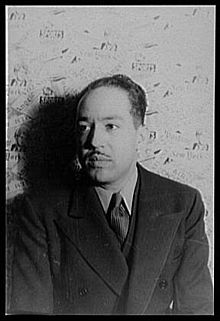
Langston Hughes
1902 - 1967
First published in The Crisis in 1921, "The Negro Speaks of Rivers", which became Hughes's signature poem, was collected in his first book of poetry The Weary Blues (1926). Hughes's life and work were enormously influential during the Harlem Renaissance of the 1920s, alongside those of his contemporaries, Zora Neale Hurston, Wallace Thurman, Claude McKay, Countee Cullen, Richard Bruce Nugent, and Aaron Douglas. Except for McKay, they worked together also to create the short-lived magazine Fire!! Devoted to Younger Negro Artists. Hughes, who claimed Paul Lawrence Dunbar, Carl Sandburg, and Walt Whitman as his primary influences, is particularly known for his insightful, colorful portrayals of black life in America from the twenties through the sixties.   As one of the founders of the Harlem Renaissance, which he practically defined in his essay, "The Negro Artist and the Racial Mountain" (1926).

Langston was more than a poet, he was an activist as well. Hughes was unashamedly black at a time when blackness was démodé. He stressed the theme of "black is beautiful" as he explored the black human condition in a variety of depths. His main concern was the uplift of his people, whose strengths, resiliency, courage, and humor he wanted to record as part of the general American experience. His poetry and fiction portrayed the lives of the working class blacks in America, lives he portrayed as full of struggle, joy, laughter, and music. Permeating his work is pride in the African-American identity and its diverse culture. "My seeking has been to explain and illuminate the Negro condition in America and obliquely that of all human kind," Hughes is quoted as saying. He confronted racial stereotypes, protested social conditions, and expanded African America’s image of itself; a “people’s poet” who sought to reeducate both audience and artist by lifting the theory of the black aesthetic into reality. An expression of this is this poem:

"My People" picture book by Charles R. Smith

"My People"
by Langston Hughes

The night is beautiful,
So the faces of my people.

The stars are beautiful,
So the eyes of my people

Beautiful, also, is the sun.
Beautiful, also, are the souls of my people.


In 1932, Hughes became part of a group of black people who went to the Soviet Union to make a film depicting the plight of African Americans in the United States. The film was never made, but Hughes was given the opportunity to travel extensively through the Soviet Union and to the Soviet-controlled regions in Central Asia, the latter parts usually closed to Westerners. While there, he met African-American Robert Robinson, living in Moscow and unable to leave. In Turkmenistan, Hughes met and befriended the Hungarian polymath Arthur Koestler. Hughes also managed to travel to China and Japan before returning to the States.

Partly as a show of support for the Republican faction during the Spanish Civil War, in 1937 Hughes traveled to Spain as a correspondent for the Baltimore Afro-American and other various African-American newspapers. Hughes initially did not favor black American involvement in the war because of the persistence of discriminatory U.S. Jim Crow laws existing while blacks were encouraged to fight against Fascism and the Axis powers. He came to support the war effort and black American involvement in it after deciding that blacks would also be contributing to their struggle for civil rights at home. When asked why he never joined the Communist Party, he wrote "it was based on strict discipline and the acceptance of directives that I, as a writer, did not wish to accept." In 1953, he was called before the Senate Permanent Subcommittee on Investigations led by Senator Joseph McCarthy.

In addition to leaving us a large body of poetic work, Hughes wrote eleven plays and countless works of prose, including the well-known “Simple” books: Simple Speaks His Mind, Simple Stakes a Claim,Simple Takes a Wife, and Simple's Uncle Sam. He edited the anthologies The Poetry of the Negro and The Book of Negro Folklore, wrote an acclaimed autobiography (The Big Sea) and co-wrote the play Mule Bone with Zora Neale Hurston.

In his memory, his residence at 20 East 127th Street in Harlem, New York City, has been given landmark status by the New York City Preservation Commission, and East 127th Street has been renamed "Langston Hughes Place."

Saturday, March 31, 2012

Happy Birthday Lizzie Miles

On March 31 in Black History…

In 1895, Lizzie Miles was born in New Orleans, Louisiana.  Miles was an African-American cabaret and blues singer. Born Elizabeth Mary Landreaux, Miles sang pop ballads, vaudeville standards, and jazz-colored blues, both in French and English. During her prime, she attracted the same kind of audience that made Edith Wilson, Alberta Hunter, and Lucille Hegamin stars. Never dubbed a classic blues woman, when she sang the blues, she sang them with conviction. 

Miles used her beauty and her huge voice to create a sophisticated, urbane style that was more suited for settings like the Cotton Club in Harlem than the tent shows of the South. Miles began her career singing in front of New Orleans bands that included such noted jazz musicians as King Oliver and Kid Ory, though, in her youth, she had worked Southern vaudeville shows and even joined up with a circus.

Eventually she left New Orleans and moved to Chicago, then to New York, Paris, and back again to New York, all the while working clubs and cabarets. She recorded for Okeh in 1921 and later did sessions for Emerson, Columbia, and Victor. Although her recording catalog isn’t large, songs such as State Street Blues demonstrate the vocal dexterity she possessed. In the late 1930s, Miles returned to New Orleans and retired. However, in the 1950s, she resumed her career, performing and recording with the Bob Scobey Band and appearing at the Monterey Jazz Festival in 1958. She retired a second time in 1959.  Read more here:
http://aaregistry.org/historic_events/view/blues-touch-creole-lizzie-miles


Trayvon Martin

Trayvon and his Dad
I hesitated to post anything about Trayvon's Martin's murder until all the facts were out.  However, at this point it seems like that may take a while so....

Here's basically what happened:  A 17 year black boy was shot in the chest by a man claiming self defense against the boy who was only carrying a bag of skittles and an Arizona iced tea on his way home from the store.

This latest article in the Miami Herald best sums up what we currently know...

http://www.miamiherald.com/2012/03/31/2725442/what-is-known-what-isnt-about.html

Either way, it brings up so many issues.  Did the neighborhood watch captain need to be on patrol with a gun?  Would it have been different if Trayvon had not been a black kid, especially since they're saying recent burglaries in the are were suspected to be done by young black men?  Does the fact that Zimmerman was Hispanic mean that he could not have been racist?  Does Florida's gun law justify the killing if he claims he felt threatened?  Does the fact that Trayvon was having some trouble in school mean he deserved to be shot and killed?  Do Black parents need to reassess what conversations they need to have with their young black sons related to race in America?  Would this case have been closed and forgotten if it weren't for social media?

These are just a few of the questions, issues that arise from this tragedy.  I think the most important question of all is....WHERE DO WE GO FROM HERE????

March in Black History

Each month we'll list daily black history notes for the month.  Here's what happened in March in Black History:


On March 31 in Black History…
In 1999, Toni Morrison wins the Pulitzer Prize for her novel Beloved
In 1901, U.S. Navy Seaman Alphonse Gerandy, serving on the US Petrel, risked his own life to safe crewmen during a fire. His Medal of Horor was presented in 1902.
In 1895, Lizzie Miles was born.

On March 30 in Black History…
In 1870, the Fifteenth Amendment was ratified, securing voting rights for all male U.S. citizens.

On March 15 in Black History…
In 1933, Leon H. Washington founded the Los Angeles Sentinel.

On March 12 in Black History…
In 1982, Charles Fuller wins the Pulitzer Prize for A Soldier's Play
In 1773, Jeanne Baptiste Pointe de Sable founded settlement now known as Chicago, Ill, 1773.
In 1912, Dorothy Height was born.
In 1936, Virginia Hamilton, juvenile fiction writer, born
In 1962, Darryl Strawberry, New York Mets controversial star outfielder was born in Los Angeles.

On March 7 in Black History…
In 1965 - Civil Rights March in Alabama
In 1985, " We Are the World" single is released to benefit African famine.
In 1945 - Anthony Bonair, photographer, born
In 1917 - Janet Collins, ballerina was born in New Orleans, Louisiana
In 1859 - Blacks Declared Non-Citizens of US - The Acting Commissioner of General Lands for the United States, J.S. Wilson, stated that blacks were not citizens of the United States, and therefore were not legally entitled to preempt public lands.In 1539 - Estavanico Dorantes, a black Moorish slave, led a Spanish expedition to the southwestern North Ameican continent in search for El Dorado, the lost City of Gold. Their search is unsuccessful and Estavanico is later killed by native peoples.


You may also enjoy...

Related Posts Plugin for WordPress, Blogger...

EH Canvas Spotlight - Flow by Monica Stewart

EH Canvas Spotlight - Flow by Monica Stewart
Flow by Monica Stewart