Showing posts with label today in black history. Show all posts

Thursday, January 9, 2025

Scholarship, Conventions and Brotherhood

Today in Black History....

In 1866, Fisk University opened for classes in Nashville, Tennessee. Barely six months after the end of the Civil War and just two years after the Emancipation Proclamation, three men - John Ogden, the Reverend Erastus Milo Cravath, and the Reverend Edward P. Smith - established the Fisk School in Nashville, name in honor of General Clinton B. Fisk of the Tennessee Freedmens Bureau, an abolitionist who helped establish the first free public schools in the south for white AND African-American children. General Fisk also provided the new institution with facilities in former Union Army barracks near the present site of Nashvilles Union Station. In 1954, Fisk became the first private black college accredited for its music programs by the National Association of Schools of Music. 

Famous Fisk alumni include Johnetta B. Cole, Mayor Marion Barry, John Hope Franklin, WEB DuBois, Congressman John Lewis, Nikki Giovani and Ida B. Wells.


In 1873, Delaware's Convention of Colored People convened in Dover to demand equal educational opportunities. The delegates adopted a powerful resolution condemning schooling discrimination: "From our population of over twenty thousand souls, or nearly one-fifth the entire population of the State, the Legislature does not provide a solitary school, nor appropriate a single dollar of State money. We hold this discrimination as against the genius of government; insulting to the laws of Congress; detrimental to the best interests of the State, and outrageous to the colored tax payers."This convention was part of the larger Colored Conventions Movement, which ran from 1830 to 1888. These gatherings of Black leaders and citizens addressed crucial issues like education, labor rights, and civil liberties, highlighting Black agency and organizational power in the fight for equality


In 1914, Phi Beta Sigma was founded at Howard University in Washington, DC. by three young African-American male students - A. Langston Taylor, Leonard F. Morse and Charles I. Brown. The founders wanted to organize a Greek letter fraternity that would exemplify the ideals of brotherhood, scholarship and service. the fraternity is the only one of its kind to aid in the creation and hold a consitutional bond with a African-American sorority. The Founders wanted its organization to be a part of the community as opposed to apart from the community. Their deep conviction for community service is embodied in its motto, "Culture for Service and Service for Humanity."


http://en.wikipedia.org/wiki/Clinton_B._Fisk 
http://www.fisk.edu/
http://www.pbs1914.org/history/
http://en.wikipedia.org/wiki/Phi_Beta_Sigma https://www.zinnedproject.org/news/tdih/convention-of-colored-people-discuss-education/

Sunday, March 1, 2020

March in Black History

March in Black History

Each month we'll list daily black history notes for the month.  Here's what happened in March in Black History:


On March 31 in Black History…
In 1999, Toni Morrison wins the Pulitzer Prize for her novel Beloved
In 1901, U.S. Navy Seaman Alphonse Gerandy, serving on the US Petrel, risked his own life to safe crewmen during a fire. His Medal of Horor was presented in 1902.
In 1895, Lizzie Miles was born.

On March 30 in Black History…
In 1870, the Fifteenth Amendment was ratified, securing voting rights for all male U.S. citizens.

On March 15 in Black History…
In 1933, Leon H. Washington founded the Los Angeles Sentinel.

On March 12 in Black History…
In 1982, Charles Fuller wins the Pulitzer Prize for A Soldier's Play
In 1773, Jeanne Baptiste Pointe de Sable founded settlement now known as Chicago, Ill, 1773. 
In 1912, Dorothy Height was born.
In 1936, Virginia Hamilton, juvenile fiction writer, born
In 1962, Darryl Strawberry, New York Mets controversial star outfielder was born in Los Angeles.

On March 7 in Black History…
In 1965 - Civil Rights March in Alabama
In 1985, " We Are the World" single is released to benefit African famine.
In 1945 - Anthony Bonair, photographer, born
In 1917 - Janet Collins, ballerina was born in New Orleans, Louisiana
In 1859 - Blacks Declared Non-Citizens of US - The Acting Commissioner of General Lands for the United States, J.S. Wilson, stated that blacks were not citizens of the United States, and therefore were not legally entitled to preempt public lands.In 1539 - Estavanico Dorantes, a black Moorish slave, led a Spanish expedition to the southwestern North Ameican continent in search for El Dorado, the lost City of Gold. Their search is unsuccessful and Estavanico is later killed by native peoples.

Saturday, August 31, 2013

August in Black History

Each month we'll list daily black history notes for the month.  Here's what happened in August in Black History.

On August 31 in Black History...
Pigeon Point in Tobago
In 1962, Trinidad-Tobago proclaimed independence. The Republic of Trinidad and Tobago is an archipelagic state in the southern Caribbean, lying just off the coast of northeastern Venezuela and south of Grenada in the Lesser Antilles. It shares maritime boundaries with other nations including Barbados to the northeast, Guyana to the southeast, and Venezuela to the south and west. Trinidad and Tobago is known for its Carnival and is the birthplace of steelpan, calypso, soca, and limbo.
Trinidad and Tobago gained its independence from the United Kingdom in 1962. The presence of American military bases in Chaguaramas and Cumuto in Trinidad during World War II profoundly changed the character of society. In the post-war period, the wave of decolonisation that swept the British Empire led to the formation of the West Indies Federation in 1958 as a vehicle for independence. Chaguaramas was the proposed site for the federal capital. The Federation dissolved after the withdrawal of Jamaica and the government chose to seek independence on its own.[citation needed]
In 1976, the country severed its links with the British monarchy and became a republic within the Commonwealth, though it retained the British Privy Council as its final Court of Appeal. Between the years 1972 and 1983, the Republic profited greatly from the rising price of oil, as the oil-rich country increased its living standards greatly. In 1990, 114 members of the Jamaat al Muslimeen, led by Yasin Abu Bakr, formerly known as Lennox Phillip, stormed the Red House (the seat of Parliament), and Trinidad and Tobago Television, the only television station in the country at the time, and held the country's government hostage for six days before surrendering. Since 2003, the country has entered a second oil boom, a driving force which the government hopes to use to turn the country's main export back to sugar and agriculture.[citation needed] Great concern was raised in August 2007 when it was predicted that this boom would last only until 2018. Petroleum, petrochemicals and natural gas continue to be the backbone of the economy. Tourism and the public service are the mainstay of the economy of Tobago, though authorities have begun to diversify the island. The bulk of tourism visitor arrival on the islands are from Western Europe.http://en.wikipedia.org/wiki/Trinidad_and_Tobago#Independence

Thomas M. Gregory
In 1879, Livingstone College was founded in Salisbury, North Carolina, began as an educational institution for clergy in the African Methodist Church (A.M.E.). It was located in a small house on seven acres of land donated by the Reverend Thurber, and was called Zion Wesley Institute. Livingstone is a coeducational, residential, church-related college located in Salisbury, N.C., largely supported by the African Methodist Episcopal Zion Church. The college consists of two schools: an undergraduate College of Arts and Sciences and a graduate school of theology named Hood Theological Seminary.   http://www.aaregistry.org/historic_events/view/livingstone-college-founded-north-carolina
In 1887, Thomas Montgomery Gregory was born in Washington, DC.  He was an African American dramatist, educator, social philosopher, and activist.  http://www.aaregistry.org/historic_events/view/thomas-montgomery-gregory-broke-ground-black-theaterIn 1842, Josephine St. Pierre Ruffin, a Black journalist and civil rights leader, was born.  http://www.aaregistry.org/historic_events/view/josephine-ruffin-activist-philanthropist-and-newspaper-publisher
In 1935, Frank Robinson, first black manager in major league baseball was born in Beaumont, Texas.
In 1979, Donald McHenry named to succeed Andrew Young as UN.


On August 30 in Black History...
Roy Wilkins at the White House in 1868
In 1966, Constance Baker Motley was confirmed as U.S. district judge and became the first Black woman on the federal bench.
In 1983, Lt. Col. Guion S. Bluford Jr. became the first Black US astronaut enters space.
In 1881, W.S. Campbell patents improved, self-setting animal trap.
In 1843, Blacks participated in a national political convention for the first time at Liberty party convention in Buffalo, New York.

In 1901, Roy Wilkins was born in St. Louis, Missouri. Wilkins was a prominent civil rights activist from the 1930s to the 1970s. Wilkins' most notable role was in his leadership of the National Association for the Advancement of Colored People (NAACP).  In 1955, Roy Wilkins was chosen to be the executive secretary of the NAACP and in 1964 he became its executive director. He had an excellent reputation as a spokesperson for the civil rights movement. One of his first actions was to provide support to civil rights activists in Mississippi who were being subject to a "credit squeeze" by members of the White Citizens Councils. http://en.wikipedia.org/wiki/Roy_Wilkins
In 1936, Buddy Guy, influential blues guitarist and singer was born in Lettsworth, LA, USA. His most popular records include "First Time I Met The Blues" and "Stone Crazy".  http://en.wikipedia.org/wiki/Buddy_guy

On August 29 in Black History...
In 1957, Congress passed the Civil Rights Act of 1957, the first federal civil rights legislation since 1875. The bill established a civil rights commission and a civil rights division in the Justice Department. It also gave the Justice Department authority to seek injunctions against voting rights infractions.
In 1962, Mal Goode becomes the first African American television news commentator when he begins broadcasting on ABC.
In 1894, Sociologist ,E. Franklin Frasier was born. 
In 1924, Dinah Washington was born. 
In 1920, Jazz musician, Charlie "Bird" Parker was born in Kansas City. 
In 1958 Michael Jackson was born.

On August 28 in Black History...
In 1963, Martin Luther King Jr gives his "I Have A Dream" speech at the Lincoln Memorial.  http://experiencinghistory.blogspot.com/2011/08/i-have-dream.html

On August 20 in Black History...
In 1989 - The first National Black Theater Festival closes in Winston-Salem, N.C.
In 1964 - President Johnson signed Economic Opportunity Act
In 1944, Spingarn Medal presented to Charles R. Drew "who set up and ran the blood plasma bank in the Presbyterian Hospital in New York City which served as one of the models for the widespread system of blood banks now in operation for the American Red Cross."
In 1941, William Herbert Gray, III (Bill Gray) was born on this day.
In  1939, The National Negro Bowling Association was organized in Detroit, Michigan and Wynston Brown became its first president.
In 1856 - Wilberforce University was established in Ohio.
In 1831, Nat Turner, a brilliant minister and moody slave, led the first slave revolt of magnitude. The revolt was crushed, but only after Turner and his band had killed some sixty whites and threw the South into panic. After hiding out, Turner was captured on October 30...
In 1830 - First National Negro Convention took place in Philadelphia, chaired by Richard.
In 1619 -Twenty Africans arrived in Jamestown, Virginia, aboard a Dutch ship. They are the first blacks to be forcibly settled as involuntary laborers in the North American British Colonies.


On August 19 in Black History...

1989 - Desmond Tutu defied apartheid laws by walking alone on a South African beach.
In 1958, youth from the NAACP Council begins sit-ins at lunch counters in Oklahoma City. The Dockum Drug Store sit-in was one of the first organized lunch-counter sit-ins for the purpose of integrating segregated establishments in the United States. The protest began in July 1958 in Wichita, Kansas at the Dockum Drug Store, a store in the old Rexall chain, in which protesters would sit at the counter all day until the store closed, ignoring taunts from counter protesters. The sit-in ended three weeks later when the owner relented and agreed to serve black patrons.

Twenty-year-old Ron Walters, president of the local NAACP Youth Council, organized the Wichita protest together with his cousin Carol Parks-Hahn. Wichita was heavily segregated in the late 1950s, with schools segregated up to high school and blacks excluded from public accommodations. While working at a job in downtown Wichita, Walters went for lunch to a Woolworth's store, which would only serve blacks bagged lunches sold from one end of the lunch counter. Seeking to find a way to protest against the practice, Walters and his cousin Carol Parks-Hahn met with attorney Frank Williams, who described a sit-in by students at a California college who ended segregation at a campus restaurant by occupying it with students reading newspapers all day long. The protest was inspired by the actions of the Little Rock Nine and the earlier Montgomery Bus Boycott. The plan they developed targeted Dockum, a downtown store that was part of the national Rexall chain, which had a lunch counter that only served white customers, starting on July 19, 1958, with ten well-dressed and polite students seeking to place orders while sitting at the lunch counter. Parks-Haun ordered a Coca-Cola from a waitress, who served it to her but then pulled it back when she realized that "store policy was not to serve colored people". Students sat quietly all day at the counters, enduring taunts and threats from white customers. After three weeks, in early August, the manager came in and said "Serve them — I'm losing too much money". Historian Gretchen Eick called the Dockum Drug Store sit-in as setting "a precedent that really began what would be a very significant strategy — a strategy that would change the way business was done in the United States". Ultimately, all of the Dockum locations in Kansas were desegregated.

Though the Dockum sit-in had attracted little media attention, on August 19, 1958 in Oklahoma City a nationally recognized sit-in at the Katz Drug Store lunch counter occurred. The protest there was led by NAACP Youth Council leader Clara Luper, a local high school teacher, together with young local students, including Luper's eight-year old daughter, who had suggested the sit-in be held. The group quickly desegregated the Katz Drug Store lunch counters. Following the Oklahoma City sit-ins, the tactic of non-violent student sit-ins spread. The widely publicized Greensboro sit-ins began more than a year later at a Woolworth's in Greensboro, North Carolina, starting on February 1, 1960, launching a wave of anti-segregation sit-ins across the South and opened a national awareness of the depth of segregation in the nation.

A 20-foot-long bronze sculpture first announced in 1998 at a cost of $3 million marks the site of the successful sit-in, with a lunch counter and patrons depicting the protest.
http://en.wikipedia.org/wiki/Dockum_Drug_Store_sit-in
http://www.thehistorymakers.com/biography/biography.asp?bioindex=627&category=educationMakers

In 1791 - Benjamin Banneker writes letter to then secretary of state Thomas Jefferson. The letter showed the hypocrisy of slavery. After departing the federal capital area, Banneker wrote a letter to Thomas Jefferson, who in 1776 had drafted the United States Declaration of Independence and in 1791 was serving as the United States Secretary of State. Quoting language in the Declaration, the letter expressed a plea for justice for African Americans. To further support this plea, Banneker included within the letter a handwritten manuscript of an almanac for 1792 containing his ephemeris with his astronomical calculations. In the letter, Banneker accused Jefferson of criminally using fraud and violence to oppress his slaves by stating:

“…Sir, how pitiable is it to reflect, that although you were so fully convinced of the benevolence of the Father of Mankind, and of his equal and impartial distribution of these rights and privileges, which he hath conferred upon them, that you should at the same time counteract his mercies, in detaining by fraud and violence so numerous a part of my brethren, under groaning captivity and cruel oppression, that you should at the same time be found guilty of that most criminal act, which you professedly detested in others, with respect to yourselves.”
http://en.wikipedia.org/wiki/Benjamin_Banneker#Letter_to_Thomas_Jefferson_on_racism


On August 18 in Black History...
In 1963, James Meredith, the first Black person admitted to the University of Mississippi, graduates from University of Mississippi, 1963.  James H. Meredith (born June 25, 1933) is an American civil rights movement figure. He was the first African American student at the University of Mississippi, an event that was a flashpoint in the American civil rights movement. Motivated by the broadcast of President John F. Kennedy's inaugural address (which did not mention civil rights per se). Meredith decided to exercise his democratic rights and apply to the University of Mississippi. Meredith's goal was to put pressure on the Kennedy administration as to the issue.  Meredith was married to Mary June Wiggins Meredith, now deceased.They had one daughter, Jessica Meredith Knight, and three sons: James, John and Joseph Howard Meredith. In 1989, the junior James Meredith (then 20) was sentenced to one year's house arrest for his role in a 1987 car crash in which two of his co-workers were killed and he suffered serious injuries. In 2002, Joseph Meredith graduated from the University of Mississippi as the most outstanding doctoral student in the School of Business Administration. Joseph had previously earned degrees from Harvard University and Millsaps College. James Meredith said of the occasion, "I think there's no better proof that White supremacy was wrong than not only to have my son graduate, but to graduate as the most outstanding graduate of the school...That, I think, vindicates my whole life." Joseph Meredith died in 2008 at age 39 of complications from lupus. At the time of his death, he was an assistant professor of finance at Texas A&M International University. He left behind a daughter, Jasmine Victoria. James Meredith currently lives in Jackson, Mississippi with his second wife, Judy Alsobrook Meredith. Meredith wrote a memoir of his days at the University of Mississippi entitled Three Years in Mississippi, published by the Indiana University Press in 1966, and also self-published several books.


On August 14 in Black History...

In 1883, Biologist and pioneer of cell division, Ernest E. Just was born.  Just was a pioneering African American biologist, academic and science writer. Just's primary legacy is his recognition of the fundamental role of the cell surface in the development of organisms. In his work within marine biology, cytology and parthenogenesis, he advocated the study of whole cells under normal conditions, rather than simply breaking them apart in a laboratory setting. Ernest also assisted three Howard students (Edgar Amos Love, Oscar James Cooper, and Frank Coleman), in establishing Omega Psi Phi Fraternity, Inc. Just was the subject of the 1983 biography Black Apollo of Science: The Life of Ernest Everett Just by Kenneth R. Manning. The book received the 1983 Pfizer Award and was a finalist for the 1984 Pulitzer Prizefor Biography or Autobiography

In 1968, Halle Berry was born.  Berry is an American actress, former fashion model, and beauty queen. Berry received an Emmy, Golden Globe, SAG, and an NAACP Image Award for Introducing Dorothy Dandridge and won an Academy Award for Best Actress and was nominated for a BAFTA Award in 2001 for her performance in Monster's Ball, becoming the first and, as of 2011, only woman of African American descent to have won the award for Best Actress. She is one of the most highly paid actresses in Hollywood and also a Revlon spokeswoman. She has been involved in the production side of several of the films in which she performed.  Before becoming an actress, Berry entered several beauty contests, finishing as the 1st runner-up in the Miss USA Pageant (1986), and coming in 6th place in the Miss World Pageant in 1986. She made her film debut with a small role in 1991's Jungle Fever. This led to starring roles in The Flintstones (1994), Bulworth (1998), X-Men (2000) and its sequels, and as Bond Girl Jinx in Die Another Day (2002). She also won the Golden Raspberry Award for Worst Actress in 2005 for Catwoman and accepted the award in person—one of the few performers to do so.

In 1959, Ervin "Magic" Johnson was born.  Johnson Jr. is a retired American professional basketball player who played point guard for the Los Angeles Lakers of the National Basketball Association (NBA). After winning championships in high school and college, Johnson was selected first overall in the 1979 NBA Draft by the Lakers. He won a championship and an NBA Finals Most Valuable Player Award in his rookie season, and won four more championships with the Lakers during the 1980s. Johnson retired abruptly in 1991 after announcing that he had contracted HIV, but returned to play in the 1992 All-Star Game, winning the All-Star MVP Award. After protests from his fellow players, he retired again for four years, but returned in 1996, at age 37, to play 32 games for the Lakers before retiring for the third and final time.  http://en.wikipedia.org/wiki/Magic_Johnson

In 1914, Dr. Herman Branson, physicist and chemist, was born in Pocohantas, Virginia. Branson was an African-American physicist, best known for his research on the alpha helix protein structure, and was also the president of two colleges.

On August 13 in Black History...
Dr. Charles Anderson
In 1919, Meteorologist, Charles Edward Anderson, PhD was born in St. Louis, Missouri.  Charles E. Anderson earned a bachelor of science degree in Chemistry in 1941 from Lincoln University and received high accolades as he graduated third in his class. Lincoln University was also the place where he met his wife-to-be, Marjorie Anderson. Upon graduating, World War II had begun and enlisted in U.S. Army Air Forces.He was assigned to the meteorology division and Anderson claims that this came about due to the process of elimination. The Army sent him, along with 150 other cadets to the University of Chicago to study meteorology. While there along with an exceptionally heavy academic course load, Anderson also underwent physical training, weapons training, and specific training in military intelligence. Anderson completed this training in May 1943 and earned his meteorological certification. Upon finishing, he was stationed in Tuskegee, Alabama where he was assigned as a weather officer for the 332nd Fighter Group now known as the Tuskegee Airmen.
After his service in Tuskegee, Anderson became a squadron weather officer and trained fighter pilots across the country. Anderson temporarily left the Army Air Corps after the war to pursue an opportunity in high polymer chemistry at the Polytechnic Institute of Brooklyn in 1946. After receiving his Master's Degree, Anderson became a research and development officer for Watson Laboratories, supervising the works of many notable German scientists. In 1955, Anderson decided to further pursue his academic studies and applied to the doctoral program in Meteorology at the Massachusetts Institute of Technology. During this time he wrote his dissertation: "A Study of the Pulsating Growth of Cumulus Clouds." Anderson earned his Ph.D. in 1960, becoming the first African American to earn a Ph.D. in Meteorology.  http://en.wikipedia.org/wiki/Charles_E._Anderson
http://www.aaregistry.org/historic_events/view/charles-anderson-scientist-born

On August 5 in Black History...

In 1962, Patrick Ewing was born in Kingston, Jamaica.  He played most of his career with the NBA's New York Knicks as their starting center and played briefly with the Seattle SuperSonics andOrlando Magic. Ewing was named as the 16th greatest college player of all time by ESPN. He won Olympic Gold Medals as a member of the 1984 and 1992 US Men's National Basketball teams. In a 1996 poll celebrating the 50th anniversary of the NBA, Ewing was selected as one of the 50 Greatest Basketball Players of All Time. On April 7, 2008 he was elected to the Basketball Hall of Fame in Springfield, Massachusetts. He was inducted into the Hall of Fame on September 5, 2008 along with former NBA coach Pat Riley and former Houston Rockets center, Hakeem Olajuwon. His number 33 was retired by the Knicks in 2003.  


Check out these sites are where I get many of the daily black history info: http://www.blackfacts.com/ http://www.dayinblackhistory.com/

Tuesday, August 6, 2013

Voting Rights Act is Signed Into Law

Today in Black History....

In 1965, President Lyndon Johnson signed the Voting Rights Act into law with Martin Luther King, Jr. and Rosa Parks in attendance.
Dr. King and President Johnson


Today, 48 years later the country has come a long way....and the journey to voter discrimination still is not over. Just this year the Supreme Court decided to strike down a central part of the landmark law.

What does this mean for us????  This means we have to work harder than ever to get out the vote and work in our local communities to ensure that we get our right to vote AND exercise it!


About the Voting Rights Act...
The Voting Rights Act of 1965 (42 U.S.C. §§ 19731973aa-6)[2] is a landmark piece of national legislation in the United States that prohibits discrimination in voting.[3] Echoing the language of the 15th Amendment, the Act prohibits states and local governments from imposing any "voting qualification or prerequisite to voting, or standard, practice, or procedure ... to deny or abridge the right of any citizen of the United States to vote on account of race or color."[4] Specifically, Congress intended the Act to outlaw the practice of requiring otherwise qualified voters to pass literacy tests in order to register to vote, a principal means by which Southern states had preventedAfrican Americans from exercising the franchise.[3] The Act was signed into law by President Lyndon B. Johnson, who had earlier signed the landmark Civil Rights Act of 1964 into law.  Read more here:  http://en.wikipedia.org/wiki/Voting_Rights_Act_of_1965

Friday, July 19, 2013

President Obama Speaks...

Here  is a video and transcript of President Obama's remarks this afternoon, without any commentary


Here is the transcript courtesy of:  

REPORTERS: Whoa!

Q: Hello.

PRESIDENT OBAMA: That’s so -- that’s so disappointing, man. Jay, is this kind of -- the kind of respect that you get? (Laughter.)

Q: Wake up!

Q: What brings you out here, Mr. --

PRESIDENT OBAMA: You know, on -- on -- on television it usually looks like you’re addressing a full room.

Q: (Laughs.) It’s just a mirage.

Q: There’s generally not --

PRESIDENT OBAMA: All right.

(Cross talk.)

Q: (Inaudible) -- got the Detroit story.

PRESIDENT OBAMA: I got you. All right. Sorry about that. Do you think anybody else is showing up? Good.

Well, I -- I wanted to come out here first of all to tell you that Jay is prepared for all your questions and is -- is very much looking forward to the session.

Second thing is I want to let you know that over the next couple of weeks there are going to obviously be a whole range of issues -- immigration, economics, et cetera -- we’ll try to arrange a fuller press conference to address your questions.

The reason I actually wanted to come out today is not to take questions, but to speak to an issue that obviously has gotten a lot of attention over the course of the last week, the issue of the Trayvon Martin ruling. I gave an -- a preliminary statement right after the ruling on Sunday, but watching the debate over the course of the last week I thought it might be useful for me to expand on my thoughts a little bit.

First of all, you know, I -- I want to make sure that, once again, I send my thoughts and prayers, as well as Michelle’s, to the family of Trayvon Martin, and to remark on the incredible grace and dignity with which they’ve dealt with the entire situation. I can only imagine what they’re going through, and it’s -- it’s remarkable how they’ve handled it.

The second thing I want to say is to reiterate what I said on Sunday, which is there are going to be a lot of arguments about the legal -- legal issues in the case. I’ll let all the legal analysts and talking heads address those issues.

The judge conducted the trial in a professional manner. The prosecution and the defense made their arguments. The juries were properly instructed that in a -- in a case such as this, reasonable doubt was relevant, and they rendered a verdict. And once the jury’s spoken, that’s how our system works.

But I did want to just talk a little bit about context and how people have responded to it and how people are feeling. You know, when Trayvon Martin was first shot, I said that this could have been my son. Another way of saying that is Trayvon Martin could have been me 35 years ago. And when you think about why, in the African- American community at least, there’s a lot of pain around what happened here, I think it’s important to recognize that the African- American community is looking at this issue through a set of experiences and a history that -- that doesn’t go away.

There are very few African-American men in this country who haven’t had the experience of being followed when they were shopping in a department store. That includes me.

And there are very few African-American men who haven’t had the experience of walking across the street and hearing the locks click on the doors of cars. That happens to me, at least before I was a senator. There are very few African-Americans who haven’t had the experience of getting on an elevator and a woman clutching her purse nervously and holding her breath until she had a chance to get off. That happens often.

And you know, I don’t want to exaggerate this, but those sets of experiences inform how the African-American community interprets what happened one night in Florida. And it’s inescapable for people to bring those experiences to bear.

The African-American community is also knowledgeable that there is a history of racial disparities in the application of our criminal laws, everything from the death penalty to enforcement of our drug laws. And that ends up having an impact in terms of how people interpret the case.

Now, this isn’t to say that the African-American community is naive about the fact that African-American young men are disproportionately involved in the criminal justice system, that they are disproportionately both victims and perpetrators of violence. It’s not to make excuses for that fact, although black folks do interpret the reasons for that in a historical context.

We understand that some of the violence that takes place in poor black neighborhoods around the country is born out of a very violent past in this country, and that the poverty and dysfunction that we see in those communities can be traced to a very difficult history.

And so the fact that sometimes that’s unacknowledged adds to the frustration. And the fact that a lot of African-American boys are painted with a broad brush and the excuse is given, well, there are these statistics out there that show that African-American boys are more violent -- using that as an excuse to then see sons treated differently causes pain.

I think the African-American community is also not naive in understanding that statistically somebody like Trayvon Martin was probably statistically more likely to be shot by a peer than he was by somebody else.

So -- so folks understand the challenges that exist for African- American boys, but they get frustrated, I think, if they feel that there’s no context for it or -- and that context is being denied. And -- and that all contributes, I think, to a sense that if a white male teen was involved in the same kind of scenario, that, from top to bottom, both the outcome and the aftermath might have been different.

Now, the question for me at least, and I think, for a lot of folks is, where do we take this? How do we learn some lessons from this and move in a positive direction? You know, I think it’s understandable that there have been demonstrations and vigils and protests, and some of that stuff is just going to have to work its way through as long as it remains nonviolent. If I see any violence, then I will remind folks that that dishonors what happened to Trayvon Martin and his family.

But beyond protests or vigils, the question is, are there some concrete things that we might be able to do? I know that Eric Holder is reviewing what happened down there, but I think it’s important for people to have some clear expectations here. Traditionally, these are issues of state and local government -- the criminal code. And law enforcement has traditionally done it at the state and local levels, not at the federal levels.

That doesn’t mean, though, that as a nation, we can’t do some things that I think would be productive. So let me just give a couple of specifics that I’m still bouncing around with my staff so we’re not rolling out some five-point plan, but some areas where I think all of us could potentially focus.

Number one, precisely because law enforcement is often determined at the state and local level, I think it’d be productive for the Justice Department -- governors, mayors to work with law enforcement about training at the state and local levels in order to reduce the kind of mistrust in the system that sometimes currently exists.

You know, when I was in Illinois I passed racial profiling legislation. And it actually did just two simple things. One, it collected data on traffic stops and the race of the person who was stopped. But the other thing was it resourced us training police departments across the state on how to think about potential racial bias and ways to further professionalize what they were doing.

And initially, the police departments across the state were resistant, but actually they came to recognize that if it was done in a fair, straightforward way, that it would allow them to do their jobs better and communities would have more confidence in them and in turn be more helpful in applying the law. And obviously law enforcement’s got a very tough job.

So that’s one area where I think there are a lot of resources and best practices that could be brought bear if state and local governments are receptive. And I think a lot of them would be. And -- and let’s figure out other ways for us to push out that kind of training.

Along the same lines, I think it would be useful for us to examine some state and local laws to see if it -- if they are designed in such a way that they may encourage the kinds of altercations and confrontations and tragedies that we saw in the Florida case, rather than defuse potential altercations.

I know that there’s been commentary about the fact that the stand your ground laws in Florida were not used as a defense in the case.

On the other hand, if we’re sending a message as a society in our communities that someone who is armed potentially has the right to use those firearms even if there’s a way for them to exit from a situation, is that really going to be contributing to the kind of peace and security and order that we’d like to see?

And for those who resist that idea that we should think about something like these “stand your ground” laws, I just ask people to consider if Trayvon Martin was of age and armed, could he have stood his ground on that sidewalk? And do we actually think that he would have been justified in shooting Mr. Zimmerman, who had followed him in a car, because he felt threatened?

And if the answer to that question is at least ambiguous, it seems to me that we might want to examine those kinds of laws.

Number three -- and this is a long-term project: We need to spend some time in thinking about how do we bolster and reinforce our African-American boys? And this is something that Michelle and I talk a lot about. There are a lot of kids out there who need help who are getting a lot of negative reinforcement. And is there more that we can do to give them the sense that their country cares about them and values them and is willing to invest in them?

You know, I’m not naive about the prospects of some brand-new federal program.

I’m not sure that that’s what we’re talking about here. But I do recognize that as president, I’ve got some convening power.

And there are a lot of good programs that are being done across the country on this front. And for us to be able to gather together business leaders and local elected officials and clergy and celebrities and athletes and figure out how are we doing a better job helping young African-American men feel that they’re a full part of this society and that -- and that they’ve got pathways and avenues to succeed -- you know, I think that would be a pretty good outcome from what was obviously a tragic situation. And we’re going to spend some time working on that and thinking about that.

And then finally, I think it’s going to be important for all of us to do some soul-searching. You know, there have been talk about should we convene a conversation on race. I haven’t seen that be particularly productive when politicians try to organize conversations. They end up being stilted and politicized, and folks are locked into the positions they already have.

On the other hand, in families and churches and workplaces, there’s a possibility that people are a little bit more honest, and at least you ask yourself your own questions about, am I wringing as much bias out of myself as I can; am I judging people, as much as I can, based on not the color of their skin but the content of their character? That would, I think, be an appropriate exercise in the wake of this tragedy.

And let me just leave you with -- with a final thought, that as difficult and challenging as this whole episode has been for a lot of people, I don’t want us to lose sight that things are getting better. Each successive generation seems to be making progress in changing attitudes when it comes to race. I doesn’t mean that we’re in a postracial society. It doesn’t mean that racism is eliminated. But you know, when I talk to Malia and Sasha and I listen to their friends and I see them interact, they’re better than we are. They’re better than we were on these issues. And that’s true in every community that I’ve visited all across the country.

And so, you know, we have to be vigilant and we have to work on these issues, and those of us in authority should be doing everything we can to encourage the better angels of our nature as opposed to using these episodes to heighten divisions. But we should also have confidence that kids these days I think have more sense than we did back then, and certainly more than our parents did or our grandparents did, and that along this long, difficult journey, you know, we’re becoming a more perfect union -- not a perfect union, but a more perfect union.

All right? Thank you, guys.

Q: Could you --

PRESIDENT OBAMA: Now you can -- now you can talk to Jay.


Tuesday, April 30, 2013

April in Black History

Today in Black History

Each month we'll list daily black history notes for the month.  Here's what happened in April in Black History:


On April 27 in Black History Month…
In 1882, Jesse Redmon Fauset was born in Snow Hill, NJ. She was an African American novelist, critic, poet, and editor known for her discovery and encouragement of several writers of the Harlem Renaissance.
http://experiencinghistory.blogspot.com/2011/01/eh-january-2011-spotlight-each-month-eh.html


On April 16 in Black History Month…
In 1924, Don Redman performed the first recorded scat vocals while a member of Fletcher Henderson's Orchestra. Scat singing is an improvised vocal instrumentation composed of nonsense syllables. Don Redman scatted a few bars of "My Papa Doesn't Two-Time No Time," recorded in New York by Columbia. Although Louis Armstrong is generally credited with having recorded the first scat vocals, Don Redman actually preceded him by two years.  http://experiencinghistory.blogspot.com/2012/04/scatgiving-songs-flavor.html


On April 14 in Black History Month…
In 1924, Robert Mugabe was born. He is an African politician and revolutionary leader and president of Zimbabwe. An educator by trade and a politician by practice, Mugabe has been the preeminent political leader in Zimbabwe for nearly two decades.  http://www.aaregistry.org/historic_events/view/robert-mugabe-typical-politician
"Jug" Gene Ammons
In 1873, the Slaughterhouse cases were decided by the Supreme Court. These had a profound affect on former Black slaves and the Fourteenth Amendment of the American Constitution. Read more here:http://www.aaregistry.org/historic_events/view/supreme-court-rules-slaughterhouse-cases
In1955, Elston Howard became the first Black man to play for the New York Yankees baseball team.
In 2002, Tiger Woods won his third master golf tournament.
In 1925, Saxophonist Gene "Jug" Ammons was born. Known by his nickname Jug, Ammons was the son of boogie-woogie pianist Albert Ammons. The younger Ammons worked with the big band of Billy Eckstine from 1944 through 1947. At that time the band included most of the great boppers of the time (Charlie Parker, Dexter Gordon, Sonny Stitt, Dizzy Gillespie, Miles Davis, Fats Navarro and Art Blakey).


On April 2 in Black History Month…
In 1918, Artist Charles White was born in Chicago, IL.

On April 1 in Black History…


In 1905, Clara McBride Hale was born in Elizabeth City, North Carolina. Hale founded Hale House, a home for infant children of drug addicts located in Harlem, NY. By 1991, Hale House cared for approximately 1,000 infants and toddlers. During her distinguished career, Hale received numerous honors and awards for her community service. She received an honorary doctorate from John Jay College of Criminal Justice and public service awards from the National Mother’s Day Committee and the Truman Award for Public Service. In 1985, during his State of the Union Address, President Ronald Reagan referred to Hale as an “American hero” for her commitment to at-risk children.The Hale House continues taking care of children today.  http://halehouse.org/?page=home  Read more here:  


Check out these sites are where I get many of the daily black history info: 
http://www.blackpast.org
http://www.blackfacts.com/ 
http://www.dayinblackhistory.com/
http://www.wikipedia.org

Thursday, April 25, 2013

Happy Birthday Ella Fitzgerald!

Ella Fitzgerald
"Just don't give up trying to do what you really want to do. Where there is love and inspiration, I don't think you can go wrong."
Ella Fitzgerald


Today in Black History....

In 1917, the First Lady of Jazz, Ella Fitzgerald was born in Newport News, Virginia. 

Here is Ella singing a few of my favorite Ella songs...


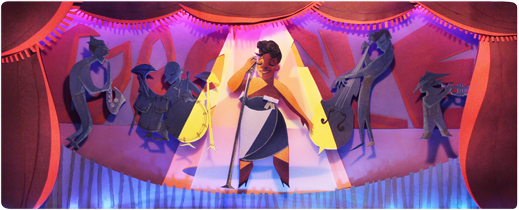
Today Google is commemorating Ella Fitzgerald's 96th birthday with it's Google doodle on its homepage. The doodle shows Ella, also known as 'Queen of Jazz', 'The First Lady of Song' and 'Lady Ella', performing on stage with a band and 'Google' emblazoned on the backdrop.
Ella Fitzgerald's 96th Birthday


ABOUT ELLA
Dubbed "The First Lady of Song," Ella Fitzgerald was the most popular female jazz singer in the United States for more than half a century. In her lifetime, she won 13 Grammy awards and sold over 40 million albums.
Ella Fitzgerald

"I sing like I feel."
Ella Fitzgerald

Her voice was flexible, wide-ranging, accurate and ageless. She could sing sultry ballads, sweet jazz and imitate every instrument in an orchestra. She worked with all the jazz greats, from Duke Ellington, Count Basie and Nat King Cole, to Frank Sinatra, Dizzy Gillespie and Benny Goodman. (Or rather, some might say all the jazz greats had the pleasure of working with Ella.)

She performed at top venues all over the world, and packed them to the hilt. Her audiences were as diverse as her vocal range. They were rich and poor, made up of all races, all religions and all nationalities. In fact, many of them had just one binding factor in common - they all loved her.
Read more about the life and legacy of Ella Fitzgerald here:
http://www.ellafitzgerald.com/about/biography.html
http://en.wikipedia.org/wiki/Ella_Fitzgerald

You may also enjoy...

Related Posts Plugin for WordPress, Blogger...

EH Canvas Spotlight - Flow by Monica Stewart

EH Canvas Spotlight - Flow by Monica Stewart
Flow by Monica Stewart