Wednesday, May 1, 2013

N.C. NAACP Fights Conservative Agenda To Weaken Voter Rights and Student Aid

NC NAACP Students Protest

"It’s a bit scary how Republican lawmakers in North Carolina are attempting to overturn standards of fairness and good-government that have stood for generations.

In fact, it seems as though they all collectively fell and bumped their heads, with Republicans having woken up to a 1920′s North Carolina where minority and poor folks had few rights that those in power had to acknowledge."

Read more here:

Tuesday, April 30, 2013

Have you had "the talk" with your Black son?

Some people like to believe we live in a post race society and that racism is dead; unfortunately, racism is not dead.  I do not advocate overreacting or scaring our kids or making them overly sensitive or teaching them that our entire identity is based on victimization...we have to tell them the truth.

In an article I ran across today, the author shared 5 of the rules he received when he got "the talk" from his parents:
  1. Never Leave A Store Without A Shopping Bag
  2. Never Loiter Outside, Anywhere
  3. Never Go Anywhere Alone
  4. Never Talk Back To Police ... And Never, Ever Reach Into Your Pocket
  5. Never Doubt Trouble May Strike Anytime, Anywhere

"One of the things that black parents have done, and rather successfully...is on the one hand talk about a sense of being aware — being cautious — while also avoiding what we call destructive paranoia." 
William Cross, Jr., Author of Shades of Black

What do you think???  Is this really a big deal???  Some people may say this is overkill, but the fact remains that there are still some people in the world, in this country, that will see your son and only see what they perceive to be their stereotyped black kid.  It is sad, but it is true.  But why should this STILL be an issue? I mean, we are living in 2013 and there is no need for civil rights for African-Americans anymore, right???  Well, as Harry Belafonte said in an interview on Monday:


"in the 50's.. everything was quite visible, now all this is underground, you go through so much fighting these 'ghosts'"

Harry Belafonte

Check out the full interview on another blog here:

April in Black History

Today in Black History

Each month we'll list daily black history notes for the month.  Here's what happened in April in Black History:


On April 27 in Black History Month…
In 1882, Jesse Redmon Fauset was born in Snow Hill, NJ. She was an African American novelist, critic, poet, and editor known for her discovery and encouragement of several writers of the Harlem Renaissance.
http://experiencinghistory.blogspot.com/2011/01/eh-january-2011-spotlight-each-month-eh.html


On April 16 in Black History Month…
In 1924, Don Redman performed the first recorded scat vocals while a member of Fletcher Henderson's Orchestra. Scat singing is an improvised vocal instrumentation composed of nonsense syllables. Don Redman scatted a few bars of "My Papa Doesn't Two-Time No Time," recorded in New York by Columbia. Although Louis Armstrong is generally credited with having recorded the first scat vocals, Don Redman actually preceded him by two years.  http://experiencinghistory.blogspot.com/2012/04/scatgiving-songs-flavor.html


On April 14 in Black History Month…
In 1924, Robert Mugabe was born. He is an African politician and revolutionary leader and president of Zimbabwe. An educator by trade and a politician by practice, Mugabe has been the preeminent political leader in Zimbabwe for nearly two decades.  http://www.aaregistry.org/historic_events/view/robert-mugabe-typical-politician
"Jug" Gene Ammons
In 1873, the Slaughterhouse cases were decided by the Supreme Court. These had a profound affect on former Black slaves and the Fourteenth Amendment of the American Constitution. Read more here:http://www.aaregistry.org/historic_events/view/supreme-court-rules-slaughterhouse-cases
In1955, Elston Howard became the first Black man to play for the New York Yankees baseball team.
In 2002, Tiger Woods won his third master golf tournament.
In 1925, Saxophonist Gene "Jug" Ammons was born. Known by his nickname Jug, Ammons was the son of boogie-woogie pianist Albert Ammons. The younger Ammons worked with the big band of Billy Eckstine from 1944 through 1947. At that time the band included most of the great boppers of the time (Charlie Parker, Dexter Gordon, Sonny Stitt, Dizzy Gillespie, Miles Davis, Fats Navarro and Art Blakey).


On April 2 in Black History Month…
In 1918, Artist Charles White was born in Chicago, IL.

On April 1 in Black History…


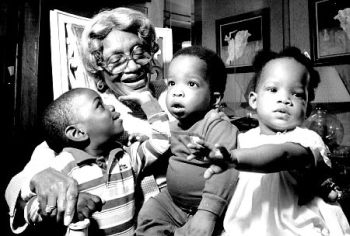
In 1905, Clara McBride Hale was born in Elizabeth City, North Carolina. Hale founded Hale House, a home for infant children of drug addicts located in Harlem, NY. By 1991, Hale House cared for approximately 1,000 infants and toddlers. During her distinguished career, Hale received numerous honors and awards for her community service. She received an honorary doctorate from John Jay College of Criminal Justice and public service awards from the National Mother’s Day Committee and the Truman Award for Public Service. In 1985, during his State of the Union Address, President Ronald Reagan referred to Hale as an “American hero” for her commitment to at-risk children.The Hale House continues taking care of children today.  http://halehouse.org/?page=home  Read more here:  


Check out these sites are where I get many of the daily black history info: 
http://www.blackpast.org
http://www.blackfacts.com/ 
http://www.dayinblackhistory.com/
http://www.wikipedia.org

International Jazz Day

"Jazz is restless. It won't stay put and it never will" 
J. J. Johnson

Jazz is a music that originated at the beginning of the 20th century, or earlier, within the African-American communities of the Southern United States. Its roots lie in the African-American adoption of European harmony and form onto existing African musical elements. Its African musical basis is evident in its use of blue notes, improvisation, polyrhythms, syncopation and the swung note. From its early development until the present day, jazz has also incorporated elements from popular music especially, in its early days, from American popular music


About International Jazz Day
In November 2011, the United Nations Educational, Scientific and Cultural Organization (UNESCO) officially designated April 30 as International Jazz Day in order to highlight jazz and its diplomatic role of uniting people in all corners of the globe. International Jazz Day is chaired and led by Irina Bokova, UNESCO Director General, and legendary jazz pianist and composer Herbie Hancock, who serves as a UNESCO Ambassador for Intercultural Dialogue and Chairman of the Thelonious Monk Institute of Jazz. The Institute is the lead nonprofit organization charged with planning, promoting and producing this annual celebration, which began in 2012.   International Jazz Day is the culmination of Jazz Appreciation Month which draws public attention to jazz and its extraordinary heritage in April.

Istanbul, Turkey has been named the 2013 Global Host City for International Jazz Day. Today, the city hosted a daylong series of jazz events including workshops and seminars, panels and round table discussions, film screenings, student master classes led by prominent musicians and educators, and a major evening performance that will be broadcast on public television stations worldwide. The Institute and UNESCO will continue their partnership to encourage schools, universities, libraries, arts organizations, community centers and other entities in UNESCO’s 195 member states to host jazz concerts and educational programs on International Jazz Day in order to reach people of all ages and backgrounds.

"Like democracy itself, jazz has structure, but within it you can say almost anything."
Susan Rice, U.S. Ambassador to the United Nations


Excerpt from Jelly Roll Morton's "New Orleans Blues" (c. 1902). The left hand plays the tresillo rhythm. The right hand plays variations on cinquillo. About this sound Play


History of Jazz
As the music has developed and spread around the world it has, since its early American beginnings, drawn on many different national, regional and local musical cultures, giving rise to many distinctive styles: New
Morton published "Jelly Roll Blues" in 1915, the first jazz work in print.
Orleans jazz dating from the early 1910s, big band swing, Kansas City jazz and Gypsy jazz from the 1930s and 1940s, bebop from the mid-1940s and on down through West Coast jazz, cool jazz, avant-garde jazz, Afro-Cuban jazz, modal jazz, free jazz, Latin jazz in various forms, soul jazz, jazz fusion and jazz rock, smooth jazz, jazz-funk, punk jazz, acid jazz, ethno jazz,jazz rap, cyber jazz, Indo jazz, M-Base, nu jazz and other ways of playing the music.  Read more here:  http://en.wikipedia.org/wiki/Jazz#History


File:Steve Coleman 1611.JPG
Steve Coleman, 2004 in Paris

Thursday, April 25, 2013

Happy Birthday Ella Fitzgerald!

Ella Fitzgerald
"Just don't give up trying to do what you really want to do. Where there is love and inspiration, I don't think you can go wrong."
Ella Fitzgerald


Today in Black History....

In 1917, the First Lady of Jazz, Ella Fitzgerald was born in Newport News, Virginia. 

Here is Ella singing a few of my favorite Ella songs...


Today Google is commemorating Ella Fitzgerald's 96th birthday with it's Google doodle on its homepage. The doodle shows Ella, also known as 'Queen of Jazz', 'The First Lady of Song' and 'Lady Ella', performing on stage with a band and 'Google' emblazoned on the backdrop.
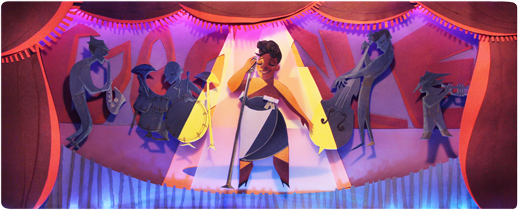
Ella Fitzgerald's 96th Birthday


ABOUT ELLA
Dubbed "The First Lady of Song," Ella Fitzgerald was the most popular female jazz singer in the United States for more than half a century. In her lifetime, she won 13 Grammy awards and sold over 40 million albums.
Ella Fitzgerald

"I sing like I feel."
Ella Fitzgerald

Her voice was flexible, wide-ranging, accurate and ageless. She could sing sultry ballads, sweet jazz and imitate every instrument in an orchestra. She worked with all the jazz greats, from Duke Ellington, Count Basie and Nat King Cole, to Frank Sinatra, Dizzy Gillespie and Benny Goodman. (Or rather, some might say all the jazz greats had the pleasure of working with Ella.)

She performed at top venues all over the world, and packed them to the hilt. Her audiences were as diverse as her vocal range. They were rich and poor, made up of all races, all religions and all nationalities. In fact, many of them had just one binding factor in common - they all loved her.
Read more about the life and legacy of Ella Fitzgerald here:
http://www.ellafitzgerald.com/about/biography.html
http://en.wikipedia.org/wiki/Ella_Fitzgerald

You may also enjoy...

Related Posts Plugin for WordPress, Blogger...

EH Canvas Spotlight - Flow by Monica Stewart

EH Canvas Spotlight - Flow by Monica Stewart
Flow by Monica Stewart