Showing posts with label black poetry. Show all posts

Wednesday, April 4, 2012

The Negro Speaks of Rivers

In honor of National Poetry Month... Langston Hughes poetry:

The Negro Speaks of Rivers 

I've known rivers: 
I've known rivers ancient as the world and 
older than the flow of human blood in human veins. 
 My soul has grown deep like the rivers. 
 I bathed in the Euphrates when dawns were young. 
I built my hut near the Congo and it lulled me to sleep. 
I looked upon the Nile and raised the pyramids above it. 
I heard the singing of the Mississippi when Abe Lincoln
 went down to New Orleans, and I've seen its muddy 
 bosom turn all golden in the sunset. 
I've known rivers: 
Ancient, dusky rivers. 
 My soul has grown deep like the rivers.

Listen to Langston read it himself here:  http://www.poets.org/viewmedia.php/prmMID/15722
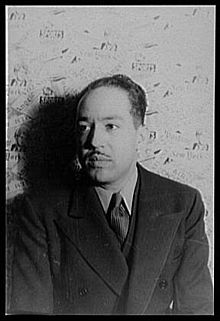
The Poetry and Leadership of Langston Hughes:
Langston Hughes
1902 - 1967
First published in The Crisis in 1921, "The Negro Speaks of Rivers", which became Hughes's signature poem, was collected in his first book of poetry The Weary Blues (1926). Hughes's life and work were enormously influential during the Harlem Renaissance of the 1920s, alongside those of his contemporaries, Zora Neale Hurston, Wallace Thurman, Claude McKay, Countee Cullen, Richard Bruce Nugent, and Aaron Douglas. Except for McKay, they worked together also to create the short-lived magazine Fire!! Devoted to Younger Negro Artists. Hughes, who claimed Paul Lawrence Dunbar, Carl Sandburg, and Walt Whitman as his primary influences, is particularly known for his insightful, colorful portrayals of black life in America from the twenties through the sixties.   As one of the founders of the Harlem Renaissance, which he practically defined in his essay, "The Negro Artist and the Racial Mountain" (1926).

Langston was more than a poet, he was an activist as well. Hughes was unashamedly black at a time when blackness was démodé. He stressed the theme of "black is beautiful" as he explored the black human condition in a variety of depths. His main concern was the uplift of his people, whose strengths, resiliency, courage, and humor he wanted to record as part of the general American experience. His poetry and fiction portrayed the lives of the working class blacks in America, lives he portrayed as full of struggle, joy, laughter, and music. Permeating his work is pride in the African-American identity and its diverse culture. "My seeking has been to explain and illuminate the Negro condition in America and obliquely that of all human kind," Hughes is quoted as saying. He confronted racial stereotypes, protested social conditions, and expanded African America’s image of itself; a “people’s poet” who sought to reeducate both audience and artist by lifting the theory of the black aesthetic into reality. An expression of this is this poem:

"My People" picture book by Charles R. Smith

"My People"
by Langston Hughes

The night is beautiful,
So the faces of my people.

The stars are beautiful,
So the eyes of my people

Beautiful, also, is the sun.
Beautiful, also, are the souls of my people.


In 1932, Hughes became part of a group of black people who went to the Soviet Union to make a film depicting the plight of African Americans in the United States. The film was never made, but Hughes was given the opportunity to travel extensively through the Soviet Union and to the Soviet-controlled regions in Central Asia, the latter parts usually closed to Westerners. While there, he met African-American Robert Robinson, living in Moscow and unable to leave. In Turkmenistan, Hughes met and befriended the Hungarian polymath Arthur Koestler. Hughes also managed to travel to China and Japan before returning to the States.

Partly as a show of support for the Republican faction during the Spanish Civil War, in 1937 Hughes traveled to Spain as a correspondent for the Baltimore Afro-American and other various African-American newspapers. Hughes initially did not favor black American involvement in the war because of the persistence of discriminatory U.S. Jim Crow laws existing while blacks were encouraged to fight against Fascism and the Axis powers. He came to support the war effort and black American involvement in it after deciding that blacks would also be contributing to their struggle for civil rights at home. When asked why he never joined the Communist Party, he wrote "it was based on strict discipline and the acceptance of directives that I, as a writer, did not wish to accept." In 1953, he was called before the Senate Permanent Subcommittee on Investigations led by Senator Joseph McCarthy.

In addition to leaving us a large body of poetic work, Hughes wrote eleven plays and countless works of prose, including the well-known “Simple” books: Simple Speaks His Mind, Simple Stakes a Claim,Simple Takes a Wife, and Simple's Uncle Sam. He edited the anthologies The Poetry of the Negro and The Book of Negro Folklore, wrote an acclaimed autobiography (The Big Sea) and co-wrote the play Mule Bone with Zora Neale Hurston.

In his memory, his residence at 20 East 127th Street in Harlem, New York City, has been given landmark status by the New York City Preservation Commission, and East 127th Street has been renamed "Langston Hughes Place."

Friday, April 1, 2011

National Poetry Month

In honor of National Poetry Month, we'll highlight poets throughout the month of April.  To kick us off, we'll start with one of my favorites in college:

Phenomenal Woman
by Maya Angelou

Pretty women wonder where my secret lies.
I'm not cute or built to suit a fashion model's size
But when I start to tell them,
They think I'm telling lies.
I say,
It's in the reach of my arms
The span of my hips,
The stride of my step,
The curl of my lips.
I'm a woman
Phenomenally.
Phenomenal woman,
That's me.

I walk into a room
Just as cool as you please,
And to a man,
The fellows stand or
Fall down on their knees.
Then they swarm around me,
A hive of honey bees.
I say,
It's the fire in my eyes,
And the flash of my teeth,
The swing in my waist,
And the joy in my feet.
I'm a woman
Phenomenally.
Phenomenal woman,
That's me.

Men themselves have wondered
What they see in me.
They try so much
But they can't touch
My inner mystery.
When I try to show them
They say they still can't see.
I say,
It's in the arch of my back,
The sun of my smile,
The ride of my breasts,
The grace of my style.
I'm a woman
Phenomenally.
Phenomenal woman,
That's me.

Now you understand
Just why my head's not bowed.
I don't shout or jump about
Or have to talk real loud.
When you see me passing
It ought to make you proud.
I say,
It's in the click of my heels,
The bend of my hair,
the palm of my hand,
The need of my care,
'Cause I'm a woman
Phenomenally.
Phenomenal woman,
That's me.
Maya Angelou

Wednesday, March 9, 2011

I Think I'll Call It Morning...

I Think I'll Call It Morning

I'm gonna take myself a piece of sunshine
and paint it all over my sky.
Be no rain. Be no rain.
I'm gonna take the song from every bird
and make them sing it just for me.
Be no rain.
And I think I'll call it morning from now on.
Why should I survive on sadness
convince myself I've got to be alone?
Why should I subscribe to this world's
madness
knowing that I've got to live on?

I think I'll call it morning from now on.
I'm gonna take myself a piece of sunshine
and paint it all over my sky.
Be no rain. Be no rain.
I'm gonna take the song from every bird
and make them sing it just for me.
Why should I hang my head?
Why should I let tears fall from my eyes
when I've seen everything that there is to see
and I know that there ain't no sense in crying!
I know that there ain't no sense in crying!
I think I'll call it morning from now on.

Gil Scott-Heron

Gil Scott-Heron (born April 1, 1949) is an American poet, musician, and author known primarily for his late 1960s and early 1970s work as a spoken word soul performer and his collaborative work with musician Brian Jackson. His collaborative efforts with Jackson featured a musical fusion of jazz, blues and soul music, as well as lyrical content concerning social and political issues of the time, delivered in both rapping and melismatic vocal styles by Scott-Heron. The music of these albums, most notably Pieces of a Man and Winter in America in the early 1970s, influenced and helped engender later African-American music genres such as hip hop and neo soul. Scott-Heron’s recording work is often associated with black militant activism and has received much critical acclaim for one of his most well-known compositions “The Revolution Will Not Be Televised”. On his influence, Allmusic wrote “Scott-Heron’s unique proto-rap style influenced a generation of hip-hop artists”.


For more about Gil Scott heron, visit his website, http://gilscottheron.net/about/.


http://www.afropoets.net/gilscottheron.html
http://en.wikipedia.org/wiki/Gil_Scott-Heron

Monday, January 31, 2011

EH Winter 2010-2011 Spotlight

Each season EH spotlights people, organizations and issues related to art, music, empowerment and our youth. Be sure to check out our Spring 2011 spotlights in March.
Here are January's Spotlights:
Canvas & Pen: Winter Spotlight:

Jessie Redmon Fauset's "There is Confusion"

“There Is Confusion” was written by Jessie Edmon Fauset. (first copywright 1924 by Boni & Livertight, Inc., ISBN 1-5553-006-4). The book primarily takes place in New York and Philadelphia right before the Harlem Renaissance, “There Is Confusion” traces the lives of Joanna Marshall and Peter Bye, whose families must come to terms with an inheritance of prejudice and discrimination as they struggle for legitimacy and respect.
Jessie Redmon Fauset was born in 1882 in Fredericksville, New Jersey into an affluent family. Her father, Redmon Fauset, was a minister whose family hailed from Philadelphia. Her mother, Anna, died when Jessie Fauset was a child. Fauset attended Cornell University from which she graduated Phi Beta Kappa in 1905. She began her professional life as a teacher, taking a teaching post in French and Latin in Washington DC in 1906. In 1919 she received a Master's degree in French from the University of Pennsylvania and honed her skills at the Sorbonne before coming to New York City.
Between 1919 and 1926, at the height of that explosion of creative activity centered in New York which was known as the Harlem Renaissance, Jessie Fauset was the literary editor of the NAACP's publication The Crisis, under the direction of W.E.B. DuBois. In addition to writing regular articles for the magazine, Fauset was responsible for fostering such notable literary greats as Langston Hughes and Jean Toomer. In the early 1920s, she also edited The Brownies Book, an NAACP publication geared toward African American children. Upon leaving her post at The Crisis, Fauset returned to teaching and taught French in the New York City schools for much of the rest of her life.
Jessie Fauset wrote all four of her novels in the remarkably prolific years between 1924 and 1931. All of these works explore race through characters and situations in which the division between black and white seems to blur. Jessie Fauset has often been criticized for portraying her almost exclusively upper-middle class characters as exemplars of "what the race is capable of doing" (Christian 41). Her detractors argue that her emphasis on blacks of so-called "genteel" culture as standard-bearers for the race silences the lives and contributions of others who are not so economically advantaged. Others assert that a close examination of the novels themselves reveals "a thematic and ironic complexity, a stylistic subtlety that few critics have seen" (McDowell x), which makes her seeming adherence to bourgeois "conventions seem less the badge of a hidebound traditionalist with prudish mid-Victorian sensibilities, and more that of a burgeoning progressive."
http://voices.cla.umn.edu/artistpages/fausetJessie.php
http://simple.wikipedia.org/wiki/Jessie_Redmon_Fauset

Melody & Drama: For Colored Girls
Winter Spotlight:

EH Pick for Favorite 2010 Drama:  For Colored Girls


Check out our post: http://experiencinghistory.blogspot.com/2010/11/and-this-is-for-colored-girls.html


Empowerment Winter Spotlight:

2010 Black History Month Theme - Black Economic Empowerment

Every year the ASALH provides a theme for Black History Month in an effort to focus the attention of the public to certain issues that merit emphasis. Last year's theme was "The History of Black Economic Empowerment"

"to honor the African Americans who overcame injustice and inequality to achieve financial independence and the security of self empowerment."
President Barack Obama
The following statement was published by the ASALH regarding the 2010 theme for Black History Month:

The need for economic development has been a central element of black life. After centuries of unrequited toil as slaves, African Americans gained their freedom and found themselves in the struggle to make a living. The chains were gone, but racism was everywhere. Black codes often prevented blacks from owning land in towns and cities, and in the countryside they were often denied the opportunity to purchase land. Organized labor shut their doors to their brethren, and even the white philanthropist who funded black schools denied them employment opportunities once educated. In the South, whites sought to insure that blacks would only be sharecroppers and day labors, and in the North whites sought to keep them as unskilled labor.

Pushing against the odds, African Americans became landowners, skilled workers, small businessmen and women, professionals, and ministers. In the Jim Crow economy, they started insurance companies, vocational schools, teachers colleges, cosmetic firms, banks, newspapers, and hospitals. To fight exclusion from the economy, they started their own unions and professional associations. In an age in which individuals proved unable to counter industrialization alone, they preached racial or collective uplift rather than individual self-reliance. The late-nineteenth and early twentieth centuries witnessed an unprecedented degree of racial solidarity and organization.  

In 1910, a group of dedicated reformers, black and white, gathered to create an organization to address the needs of African Americans as they migrated to the cities of the United States. The organization that they created a century ago became what we all know as the National Urban League. For a century, they have struggled to open the doors of opportunity for successive generations, engaging the challenges of each age. ASALH celebrates the centennial of the National Urban League by exploring racial uplift and black economic development in the twentieth century.

Read more about the National Urban Leage here: http://www.nul.org/
http://www.asalh.org/files/AA_History_Proclamation.pdf
http://asalh.org/files/2010_Executive_Summary.doc


Legacy Winter Spotlight- National Legacy Visionary Project


The National Visionary Leadership Project (NVLP)
The National Visionary Leadership Project is doing a wonderful work as it aims to empower future leaders by gathering the wisdom of elder generations and passing it on to the next generation. The project was co-founded in 2001 by Camille O. Cosby, Ed.D and Renee Poussaint.  What makes this project a most valuable contribution to our legacy is the fact that hands on learning opportunities are provided as students are equippred and trained on how to conduct interviews of community leaders themselves. 
http://www.visionaryproject.org/about/index.asp

Monday, January 3, 2011

Harlem Renaissance

"Sometimes I feel discriminated against, but it does not make me angry. It merely astonishes me. How can anyone deny themselves the pleasure of my company? It's beyond me." 

It’s been almost 100 years since the Harlem Renaissance started in New York and Black people in America are experiencing a similar renaissance today. In the spirit of the Renaissance, this year I’ll spotlight some of today’s experience while honoring our past as well. (scroll to bottom of this post to see 2 Cab Calloway Performances) Each month, the posts and pages on this blog will feature contemporary artists, writers and leaders.

Let’s start with a little history about the Harlem Renaissance itself…

"The Harlem Renaissance was a cultural movement that spanned the 1920s and 1930s. After the American civil war, liberated African-Americans searched for a safe place to explore their new identities as free men and women. They found it in Harlem which became home to some of the best and brightest minds of the 20th century, gave birth to a cultural revolution, and earned its status as "the capital of black America." At the time, it was known as the "New Negro Movement", named after the 1925 anthology by Alain Locke. Though it was centered in the Harlem neighborhood of New York City, many French-speaking black writers from African and Caribbean colonies who lived in Paris were also influenced by the Harlem Renaissance." 

June 1925 Cover of Opportunity
During this time, arts and venues such as the Cotton Club as well as literature flourished such as "Opportunity:  A Journal of Negro Life" which was published from 1923 to 1949 by the National Urban League. The editor, Charles S. Johnson, aimed to give voice to black culture, hitherto neglected by mainstream American publishing.  To encourage young writers to submit their work, Johnson sponsored three literary contests. In 1925 the winners included Zora Neale Hurston, Langston Hughes, and Countee Cullen. Ebony and Topaz, A Collectanea (1927) was an anthology of the best works published in the magazine.  Other organizations and movements such as the NAACP and Marcus Garvey's "Back to Africa" movement were also birthed during this time as well.

Timeline:  http://www.math.buffalo.edu/~sww/circle/harlem-ren-sites.html


Fauset, Washington, Hurston, DuBois, Garvey
A Few Key Figures:
James Weldon Johnson
Jean Toomer
Jessie Redmon Fauset
Claude McKay
Zora Neal Hurston
Langston Hughes
WEB DuBois
Alain Locke
Marcus Garvey
Lena Horne
Duke Ellington
Ma Rainey
Cab Calloway
Marian Anderson
Louis Armstrong
Booker T. Washington
*******************************************************
See these two videos of Cab in the 50's and Cab 30 years later....he still had it!


http://www.britannica.com/EBchecked/topic/430250/Opportunity#http://www.biography.com/blackhistory/harlem-renaissance.jsp
http://en.wikipedia.org/wiki/Harlem_Renaissance 

Monday, November 29, 2010

A Negro Love Song

"Heart and Soul" by John Holyfield
"Seen my lady home las' night,
Jump back, honey, jump back.
Hel' huh han' an' sque'z it tight,
 Jump back, honey, jump back.
Hyeahd huh sigh a little sigh,
Seen a light gleam f'om huh eye,
An' a smile go flittin' by -
Jump back, honey, jump back.  

Hyeahd de win' blow thoo de pine,
 Jump back, honey, jump back.
Mockin'-bird was singin' fine,
Jump back, honey, jump back.
An' my hea't was beatin' so,
When I reached my lady's do',
Dat I could n't ba' to go -
Jump back, honey, jump back.


Put my ahm aroun' huh wais',
Jump back, honey, jump back.
Raised huh lips an' took a tase,
Jump back, honey, jump back.
Love me, honey, love me true?
 Love me well ez I love you?
An' she answe'd, "'Cose I do"-
Jump back, honey, jump back."
Paul Laurence Dunbar

Paul Laurence Dunbar was the first African-American to gain national eminence as a poet. Born in 1872 in Dayton, Ohio, he was the son of ex-slaves and classmate to Orville Wright of aviation fame.

Although he lived to be only 33 years old, Dunbar was prolific, writing short stories, novels, librettos, plays, songs and essays as well as the poetry for which he became well known. He was popular with black and white readers of his day, and his works are celebrated today by scholars and school children alike. 
1975 US Postage Stamp

His style encompasses two distinct voices -- the standard English of the classical poet and the evocative dialect of the turn-of-the-century black community in America. He was gifted in poetry -- the way that Mark Twain was in prose -- in using dialect to convey character.

In Paul's short life, he produced 12 books of poetry, four books of short stories, a play and five novels. 
Read more about Paul Laurence Dunbar at:  http://www.dunbarsite.org/biopld.asp


Wednesday, November 17, 2010

Gathering Sounds

"I gather up each sound you left behind and stretch them on our bed.
each nite I breathe you and become high."  
Sonia Sanchez

Sonia Sanchez
 Renown poet and professor, Sonia Sanchez has been known for her innovative melding of musical formats - like the blues - and traditional poetic formats like haiku and tanka.  Sanchez was the first to create and teach a course based on Black Women and literature in the United States.

Here's Sonia reciting, "Put On the Sleeves of Love" from her upcoming book, Morning Haiku, which will be published January 25, 2011.  Check out her website at http://www.soniasanchez.net/.

I was first introduced to Sonia Sanchez in the movie, love jones when Nina quoted the poem above to when talking to Darius on a date.  Nina's character said that Sanchez's poems made her want to burn her notebook...and I thought, "now I just HAVE to read those poems."
Stay tuned as we highlight black poets monthly.

Tuesday, November 9, 2010

And This is for Colored Girls....

"When I die, I will not be guilty of having left a generation of girls behind thinking that anyone can tend to their emotional health better than themselves."
Ntzoke Shange


We have to tell our stories..in the telling comes understanding...and with understanding comes healing and power. For Colored Girls Who Have Considered Suicide, When the Rainbow is Enuf, shares 20 poems, stories of black women that speak to the fabric of a portion of the African diasporic experience. In 1975, this choreopoem was brought to the stage and 35 years later it was brought to the big screen telling the story of colored girls who have considered suicide.

It has been said that suicide is what happens when the pain excees the resources for coping. Other research has shown that people are most suicidal when they enter a state of psychosis and misinterpret reality perceiving there is no hope. In the poem, "A Night With Beau Willie Brown" it says, "she could only whisper, and he dropped them." In the midst of all the abuse, this colored girl had lost her voice, her power. In the movie we see that this was a woman who had definitely considered suicide at a point when all hope was lost.

What's most hopeful about the movie is that the stories are brought to life in such a way as to highlight the power of the black woman. Each story's tragedy teaches lessons of what could have been done with the power these women possessed. Crystal had the power to protect her kids. Tangie did have the power to protect her sister. Juanita and Jo both had the power to protect themselves.

"I LOVED YOU ON PURPOSE..."

African-American women also have an amazing gift of love...love that heals, grounds and attracts love from others. Through all 20 of the poems, each black woman realizes that her love is too delicate, too beautiful, too sanctified, too magic, too saturday night, too complicated and too music to be thrown back into her face. Our love is too vital to the fabric that weaves us together to have it wasted. My love is too powerful to allow someone else to "walk off wid alla my stuff." Each black woman needs to speak her own truth:
"MY LOVE IS TOO..."

The author, born as Paulette Williams, changed her name to Ntzoke (she who comes with her own things) Shange (who walks like a lion) in 1971. The stories Shange shares with us in "For Colored Girls Who Have Considered Suicide, When the Rainbow is Enuf" shows that each colored girl comes with her own things...the power of love, a voice and the power to protect...and these gifts enable her to walk as a lioness.
"& this is for colored girls who have considered suicide/but are movin to the end of their rainbows"

You may also enjoy...

Related Posts Plugin for WordPress, Blogger...

EH Canvas Spotlight - Flow by Monica Stewart

EH Canvas Spotlight - Flow by Monica Stewart
Flow by Monica Stewart